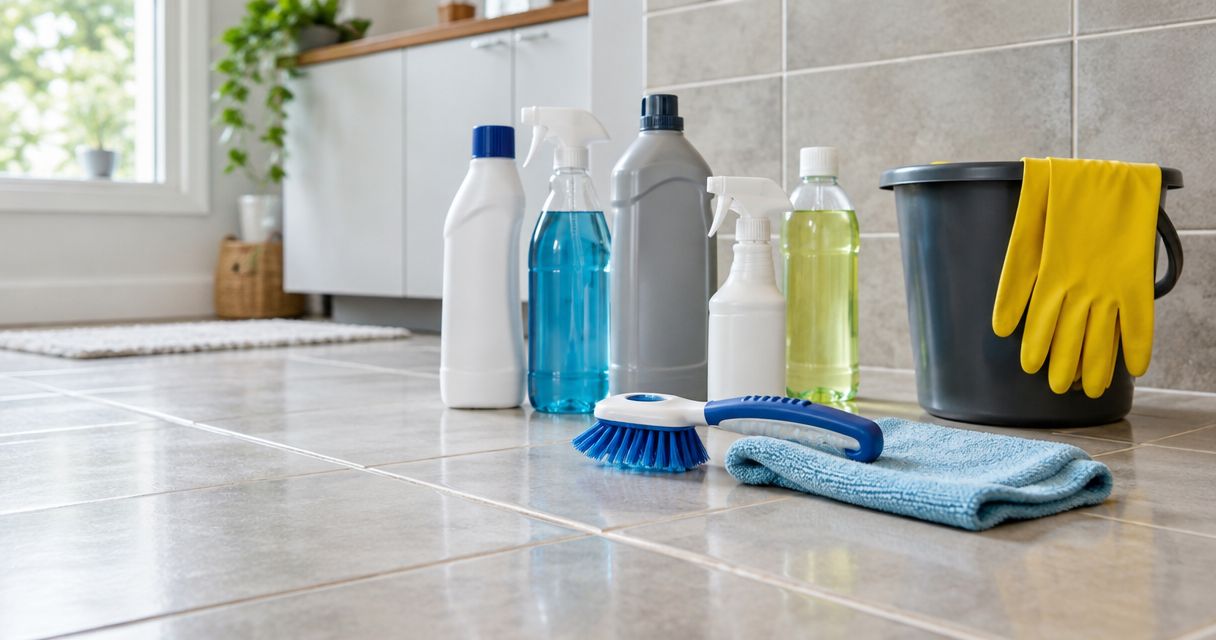
Best overall: a pH-neutral tile cleaner. Best for natural stone: a stone-specific cleaner. Best for precise scrubbing: a nylon grout brush. This 2026 guide compares eight types of tile and grout cleaning products; Michaels Carpet Care provides professional tile, grout, and natural stone cleaning in McKinney, Frisco, Plano, and Allen.
- The best tile and grout cleaning products match your surface and stain; start with a pH-neutral cleaner.
- Choose a stone-specific cleaner for marble, limestone, or travertine; avoid acidic cleaners on these surfaces.
- A nylon grout brush adds targeted agitation without introducing another chemical.
- Michaels Carpet Care provides professional tile and grout cleaning for North Texas homeowners and businesses.
Why this matters
The strongest cleaner is not automatically the right cleaner. Grease, mineral deposits, mildew, and ordinary tracked-in dirt require different approaches. A cleaner that addresses one problem can damage a surface beside it.
Tile and grout also behave differently. Glazed tile has a different surface from porous cement-based grout, while marble and limestone introduce another set of restrictions. Your 2026 shopping decision should start with the material under the dirt, not the darkest stain.
A clean-looking joint is not proof that grout is disinfected, and a discolored joint is not always dirty. Worn grout, damaged sealant, and permanent staining need a different response from another round of scrubbing.
What makes the best tile and grout cleaning products?
Use these criteria before choosing a bottle or tool:
- Surface compatibility: The label must cover your tile, grout, and any adjacent stone. A ceramic-tile claim does not establish marble compatibility.
- Soil match: Use a cleaner intended for the problem: routine dirt, oily residue, organic staining, or mineral deposits.
- Gentleness: Start with the least aggressive suitable option. Stronger chemistry belongs in a specific job, not every cleaning session.
- Workability: Follow the stated dilution, contact time, application, and removal instructions. Do not improvise a stronger mixture.
- Residue removal: Choose a process that lets you remove loosened dirt and cleaner rather than spread them into another joint.
- Clear limitations: A useful label explains exclusions. Avoid a product whose surface restrictions are unclear.
At room temperature, pH 7 is neutral; below pH 7 is acidic, and above pH 7 is alkaline. That distinction helps identify cleaner types, but pH alone does not establish whether a formula is safe for your floor.
Tile and grout cleaning products at a glance
These are product categories, not a brand-by-brand performance ranking. Each earns a different job, so use the table to match your problem rather than buy everything listed.
| Rank and product type | Best for | Standout feature | Key limitation |
|---|---|---|---|
| 1. pH-neutral tile cleaner | Routine maintenance | A gentle starting point for compatible surfaces | Not a dedicated solution for heavy grease or mineral buildup |
| 2. Alkaline grout cleaner | Oily kitchen residue | Chemistry intended for greasy soil | Requires careful surface checks and residue removal |
| 3. Oxygen bleach powder | Compatible grout with organic staining | Oxygen-releasing cleaning action | Not suitable for every grout, finish, or nearby material |
| 4. Hydrogen peroxide cleaner | Localized oxidizable stains | Targeted oxidation | Can affect color; compatibility testing matters |
| 5. Stone-specific cleaner | Natural stone maintenance | Instructions centered on stone compatibility | Routine formulas do not remove every deep stain |
| 6. Acidic mineral-deposit remover | Mineral buildup on approved surfaces | Chemistry directed at mineral deposits | Can etch calcareous stone and attack cement-based grout |
| 7. Registered disinfectant cleaner | Labeled microbial treatment | Defined directions for a specific disinfecting claim | Cleaning and disinfecting are separate tasks |
| 8. Nylon grout brush | Focused mechanical cleaning | Direct agitation inside grout joints | Does not replace suitable cleaning chemistry |
1. pH-neutral tile cleaner: best for routine maintenance
A pH-neutral tile cleaner is the default starting point for routine dirt on surfaces its label approves. Use it to maintain the floor between deeper cleaning jobs, not to force a dramatic change in heavily stained grout.
Choose a formula with clear directions for your tile and grout. Neutral chemistry is a useful starting point, but the other ingredients and the surface manufacturer's instructions still matter.
pH-neutral tile cleaner pros:
- Suits a maintenance-first cleaning approach.
- Avoids starting with aggressive acidic chemistry.
- Offers a straightforward option when the label covers both tile and grout.
pH-neutral tile cleaner cons:
- Does not specifically target every mineral or oily deposit.
- Leaves residue if you apply or remove it incorrectly.
Best for: Regular floor care when the material is known and the soil is ordinary.
Verdict: Buy a compatible pH-neutral cleaner as your everyday starting point in 2026.
2. Alkaline grout cleaner: best for oily kitchen residue
An alkaline grout cleaner targets greasy soil rather than ordinary dust alone. It belongs on your shortlist when kitchen grout holds oily residue that routine cleaning does not remove.
Check the permitted surfaces, dilution, and removal instructions before application. Protect adjacent materials according to the label, and do not treat a stronger concentration as a shortcut.
Alkaline grout cleaner pros:
- Matches oily soil more directly than a maintenance cleaner.
- Supports targeted cleaning of greasy grout joints.
- Provides a distinct next step after compatible routine cleaning fails.
Alkaline grout cleaner cons:
- Some formulas exclude particular finishes or materials.
- Incomplete removal leaves cleaner and loosened soil behind.
Best for: Greasy grout on tile assemblies explicitly approved by the product label.
Verdict: Buy for an identified grease problem; skip as an automatic replacement for daily maintenance.
3. Oxygen bleach powder: best for compatible organic staining
Oxygen bleach powders commonly use sodium percarbonate, which releases hydrogen peroxide when dissolved in water. Their cleaning action differs from chlorine bleach, but that difference does not make every oxygen bleach product suitable for every floor.
Look for explicit tile and grout directions. Mixing, application, and removal requirements belong to the individual product, so do not substitute a homemade recipe for its instructions.
Oxygen bleach powder pros:
- Provides oxidizing action for suitable organic stains.
- Offers an alternative to chlorine-based chemistry.
- Supports targeted treatment when the label permits grout use.
Oxygen bleach powder cons:
- Requires preparation rather than simple ready-to-use application.
- Can affect sensitive colors, finishes, or nearby materials.
Best for: Organic discoloration on grout and tile that the manufacturer explicitly approves.
Verdict: Hold until you confirm compatibility and complete an inconspicuous test. Do not use it simply because the packaging describes it as oxygen-based.
4. Hydrogen peroxide cleaner: best for localized stain treatment
A hydrogen peroxide cleaner uses oxidation to address suitable stains. Choose a formulated product with tile or grout instructions rather than assume a general-purpose peroxide bottle supplies the right cleaning process.
A small stain is a better starting point than coating an entire room. Test an inconspicuous area first, then assess the dry result before extending treatment.
Hydrogen peroxide cleaner pros:
- Supports focused treatment instead of whole-floor application.
- Targets stains susceptible to oxidation.
- Gives you a distinct option when ordinary soil removal is insufficient.
Hydrogen peroxide cleaner cons:
- Can alter color on sensitive materials.
- Does not repair grout damage or solve mineral buildup by default.
Best for: A localized, compatible stain with clear product directions.
Verdict: Hold until the spot test passes. For 2026 maintenance, keep targeted stain treatment separate from your routine floor-cleaning product.
5. Stone-specific cleaner: best for natural stone maintenance
A stone-specific cleaner is the first category to consider for marble, limestone, travertine, and other natural stone. The important distinction is explicit approval for your particular stone, not a broad promise to clean all hard surfaces.
Michaels Carpet Care provides natural stone cleaning as well as tile and grout cleaning. When a floor combines stone and grout, the cleaning choice must respect both materials.
Stone-specific cleaner pros:
- Centers the decision on stone compatibility.
- Avoids treating natural stone like ordinary glazed tile.
- Supports routine care without defaulting to acidic deposit removers.
Stone-specific cleaner cons:
- A maintenance formula does not resolve every deep stain.
- Cleaning cannot reverse acid etching or physical wear.
Best for: Routine maintenance of identified natural stone.
Verdict: Buy a cleaner approved for your stone. Skip acidic household substitutes on marble, limestone, and travertine.
6. Acidic mineral-deposit remover: best for approved mineral buildup
An acidic mineral-deposit remover addresses deposits such as limescale on surfaces its label permits. It is a specialist product, not an all-purpose grout brightener.
Acids react with calcium carbonate in marble, limestone, and travertine, causing etching. Acidic cleaners can also attack cement-based grout, so a tile-compatible claim alone is not enough.
Acidic mineral-deposit remover pros:
- Targets mineral deposits rather than greasy soil.
- Gives approved surfaces a problem-specific cleaning option.
- Helps distinguish deposit removal from routine maintenance.
Acidic mineral-deposit remover cons:
- Can permanently etch calcareous natural stone.
- Can damage cement-based grout and adjacent sensitive materials.
Best for: Identified mineral buildup where the label explicitly covers the entire exposed assembly.
Verdict: Skip when your stone, grout, or finish is unidentified. Use only when the product directions and surface instructions agree.
7. Registered disinfectant cleaner: best for labeled microbial treatment
Choose an EPA-registered disinfectant when you need the specific disinfecting action stated on its label. In the United States, registration and label directions define the surfaces, organisms, and application conditions covered by that claim.
Visible soil removal and disinfection are different tasks. A label that covers a hard, nonporous tile surface does not automatically establish the same result inside porous grout.
Registered disinfectant cleaner pros:
- Provides defined instructions for a stated disinfecting claim.
- Separates microbial treatment from cosmetic brightening.
- Identifies required application conditions on the label.
Registered disinfectant cleaner cons:
- Does not automatically cover porous grout.
- Does not correct the moisture source behind recurring mildew.
Best for: A specific microbial concern on a surface the disinfectant label covers.
Verdict: Buy only for the labeled purpose. Skip routine disinfectant use as a substitute for removing dirt or correcting persistent moisture.
8. Nylon grout brush: best for focused mechanical cleaning
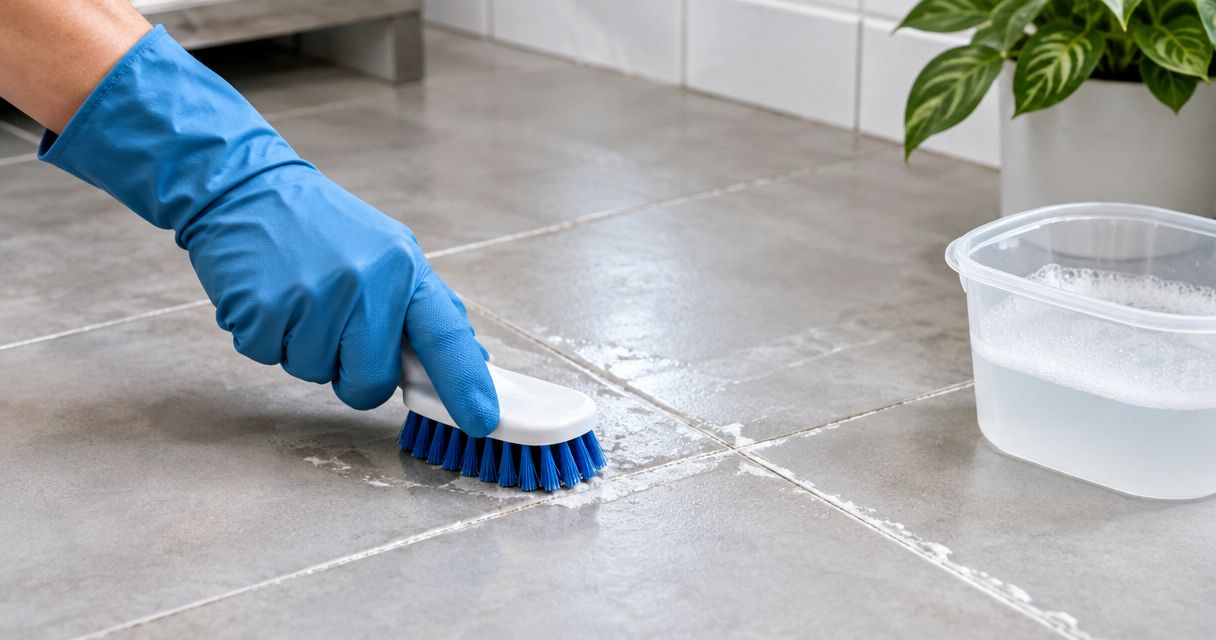
A nylon grout brush works a compatible cleaner into joints and helps loosen soil. Its narrow shape gives you more control than scrubbing the entire floor with a broad pad.
Use controlled pressure, especially around cracked or deteriorating grout. A brush is a cleaning tool, not a way to scrape damaged joints back into sound condition.
Nylon grout brush pros:
- Directs agitation where grout holds dirt.
- Adds mechanical cleaning without another chemical.
- Makes small-area treatment easier to control.
Nylon grout brush cons:
- Cannot dissolve every deposit by itself.
- Aggressive scrubbing can worsen already damaged grout.
Best for: Targeted joint cleaning alongside a surface-compatible cleaner.
Verdict: Buy for sound grout that needs careful agitation. Skip wire brushes and forceful scraping on delicate or damaged joints.
How these product types are ranked
This 2026 ranking prioritizes compatibility and gentleness before specialized stain removal. The default product handles routine maintenance; the remaining options earn narrower jobs based on soil type, material, or cleaning purpose.
No single cleaner wins every task. Stone-specific care outranks mineral-removal strength on marble, while an appropriate alkaline cleaner is the more relevant category for greasy kitchen grout. A nylon brush supports either suitable process without pretending to replace chemistry.
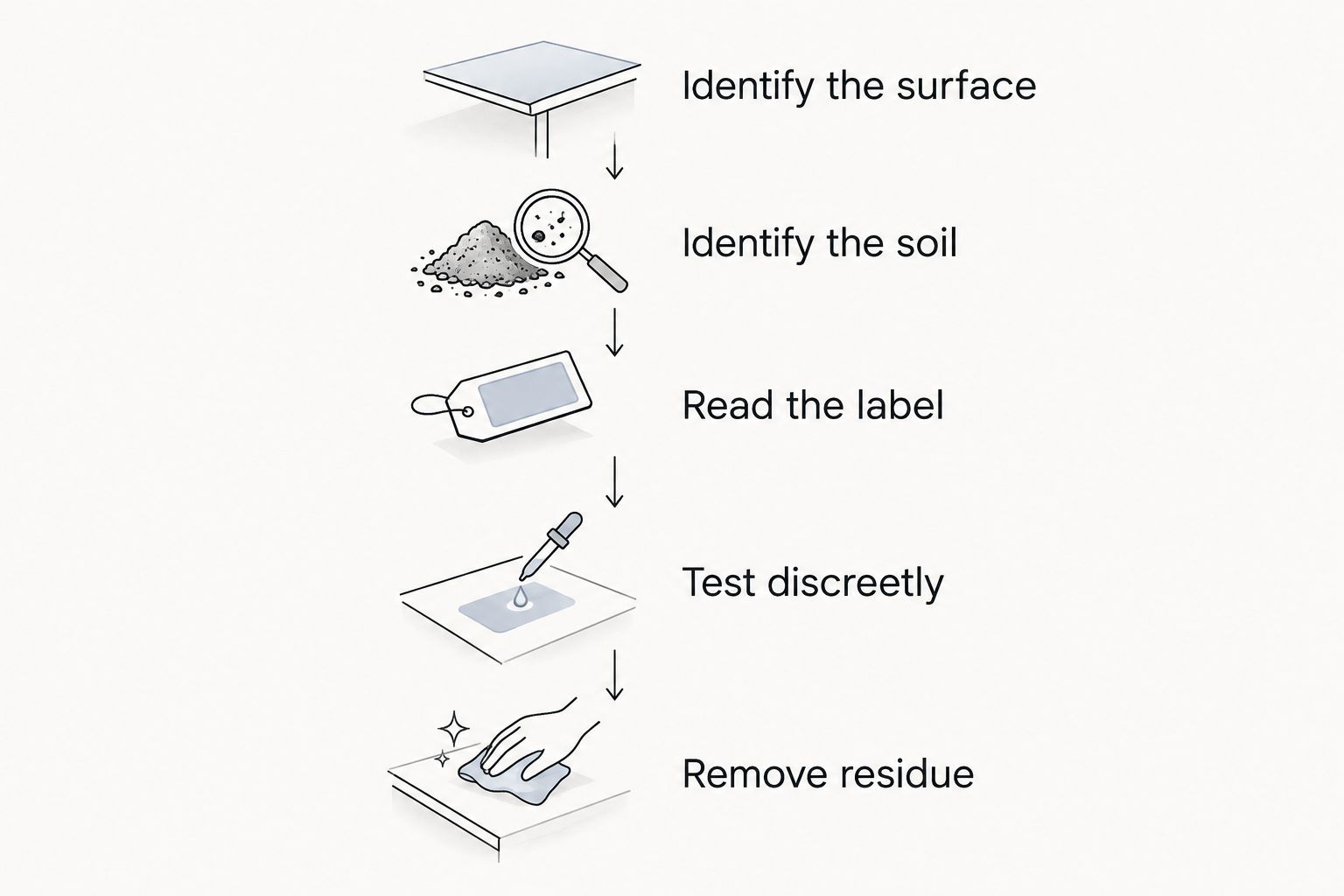
Choose your cleaner in this order
- Identify the surface: Establish whether you have ceramic, porcelain, natural stone, or another material; identify the grout where possible.
- Identify the soil: Separate ordinary dirt from oily residue, mineral deposits, organic staining, and physical damage.
- Read the label: Check every exposed material, not just the tile face.
- Test discreetly: Follow the directions in an inconspicuous area and assess the dry result.
- Remove residue: Collect loosened soil and finish the removal process the label requires.
This order prevents a common mistake: choosing stronger chemistry before checking whether the floor can tolerate it. If the test produces dullness, color change, or grout deterioration, stop rather than repeat the treatment.
Never mix cleaning chemicals. In particular, mixing chlorine bleach with acids or ammonia can release hazardous gases. Changing products means following their removal instructions, not layering another formula onto the first.
Which tile and grout cleaning product should you choose?
Choose a compatible pH-neutral cleaner if you are undecided. Add a nylon grout brush for controlled agitation, and move to specialist chemistry only after identifying a problem the everyday cleaner does not address.
For natural stone, make explicit stone compatibility your deciding criterion. For recurring discoloration, distinguish removable soil from moisture problems, damaged grout, and surface wear before buying another treatment.
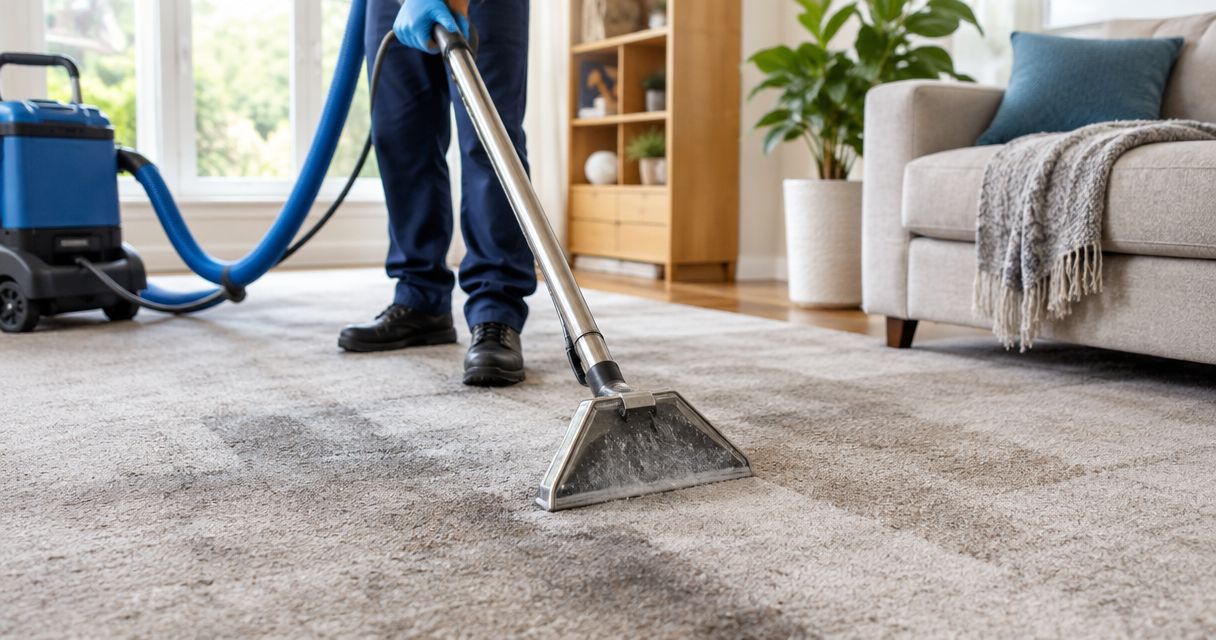
Michaels Carpet Care is the service option for North Texas homeowners who want tile and grout cleaning handled professionally. The company serves homeowners and businesses in McKinney, Frisco, Plano, and Allen, including those with natural stone cleaning needs.
Discuss your tile cleaning needs
Ask about tile, grout, and natural stone cleaning in McKinney, Frisco, Plano, and Allen.
FAQ
What's the best tile and grout cleaning product for everyday use?
A pH-neutral cleaner approved for your tile and grout is the best starting point for everyday use. Follow its application and removal directions; neutral pH does not replace a compatibility check.
Is an alkaline grout cleaner better than a neutral cleaner?
An alkaline grout cleaner is the more relevant category for oily residue when its label approves your surfaces. A neutral cleaner remains the default for routine maintenance.
Can I use vinegar on marble or travertine tile?
Do not use vinegar on marble or travertine. Its acidity can etch these calcium-carbonate-based stones; choose a cleaner explicitly approved for the material.
Is oxygen bleach safe for all grout?
Oxygen bleach is not universally safe for every grout, color, or surrounding finish. Use only a product that permits your application and test an inconspicuous area according to its directions.
Will a disinfectant clean and disinfect porous grout?
A disinfectant's label determines whether it covers porous grout. A claim for hard, nonporous tile does not automatically apply to grout, and visible dirt removal is separate from disinfection.
Why does my grout still look dark after cleaning?
Dark grout is not proof that removable dirt remains. Permanent staining, moisture, worn material, or damage can affect its appearance; identify the cause before repeating chemical treatment.
When should I book professional tile and grout cleaning?
Book professional cleaning when compatible routine care does not remove the soil or when you need help with natural stone cleaning. Michaels Carpet Care provides tile, grout, and natural stone cleaning for homeowners and businesses in its North Texas service areas.
One last thing
A dull patch on marble can be etching rather than dirt. More cleaner will not restore a surface that acid has changed. For your 2026 cleaning routine, treat an unchanged stain or altered finish as a reason to reassess the problem—not a reason to increase concentration.