Yes—water-damaged carpet can sometimes be saved with professional cleaning, but only when the water source, drying progress, and carpet condition support keeping it. In 2026, the key distinction remains the same: cleaning removes soil, while water-damage recovery must also address moisture in the padding and floor beneath it.
- Can water damaged carpet be saved with professional cleaning? Sometimes; contamination and hidden moisture determine whether cleaning is appropriate.
- EPA guidance calls for drying clean-water-damaged carpet and backing within 24–48 hours to help prevent mold growth.
- Sewage-contaminated carpet and padding should be discarded, not treated as an ordinary cleaning job.
- Michaels Carpet Care is best for North Texas homeowners seeking routine carpet cleaning after water-damage concerns are resolved.
Why this matters
A carpet can feel dry under your hand while its padding remains wet. Cleaning the visible surface does not establish that the floor assembly is dry, and a fresh scent does not establish that contamination is gone.
For your 2026 cleanup decision, separate emergency water removal from routine carpet care. Michaels Carpet Care provides residential and commercial carpet cleaning in McKinney, Frisco, Plano, and Allen; arrange a water-damage assessment before treating a soaked room as a normal cleaning appointment.
The goal is not to save carpet at any cost. It is to keep carpet only when its condition and the materials underneath justify that decision.
Can water-damaged carpet be saved with professional cleaning?
Professional cleaning is a finishing step for salvageable carpet, not a replacement for extraction, structural drying, or contamination assessment. A restorer must first determine where the water came from, where it traveled, and whether the carpet, padding, and subfloor can be properly addressed.
EPA's Mold Remediation in Schools and Commercial Buildings includes guidance for responding to clean-water damage within 24–48 hours. For carpet and backing, it calls for water extraction and drying, including attention to the floor underneath. That guidance is a prevention target—not a promise that every carpet dried within that period is safe to keep.
| Approach | Best for | What it accomplishes | Main limitation |
|---|---|---|---|
| Professional carpet cleaning | Salvageable carpet after moisture and contamination concerns are resolved | Removes remaining soil and treats suitable spots | Does not establish that padding or the subfloor is dry |
| Water-damage restoration | Recent wetting that needs extraction, drying, and assessment | Addresses water and affected building materials | Does not guarantee that carpet or padding can be retained |
| Carpet and padding replacement | Sewage contamination or materials judged unsalvageable | Removes affected porous flooring materials | Does not fix the leak or dry the underlying floor |
These approaches are not interchangeable. A room can need restoration first and cleaning later, or removal instead of cleaning.
What should happen before cleaning?
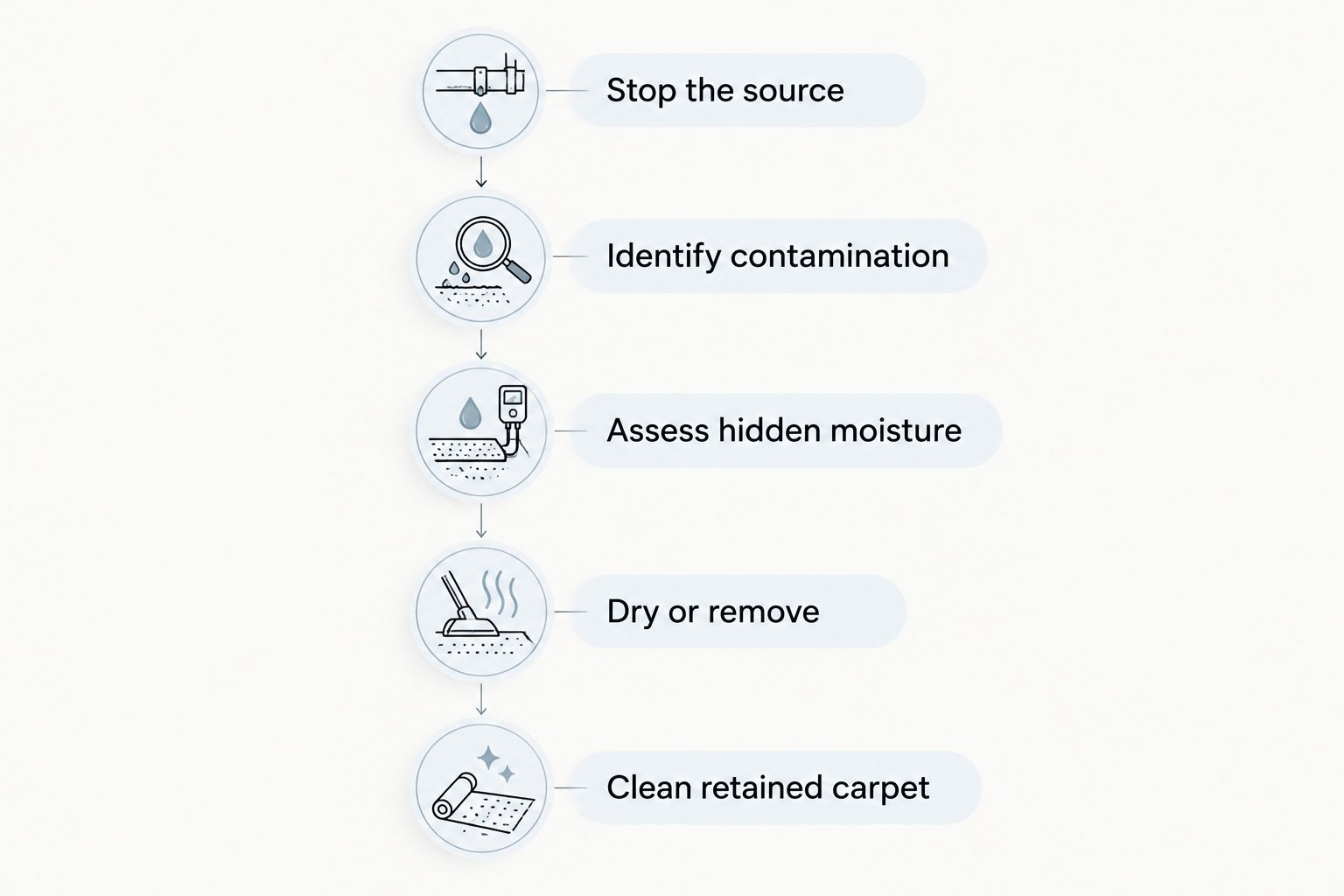
- Stop the source. Shut off a leaking supply only if you can reach it safely. Stay out of standing water when electrical hazards are possible.
- Identify contamination. Tell the restoration professional whether the water involved a supply line, drain, toilet, appliance, roof leak, or outdoor flooding.
- Assess hidden moisture. Have the carpet, padding, subfloor, and adjacent materials evaluated rather than judging dryness by touch.
- Dry or remove. Let the assessment determine which materials need extraction and drying and which need removal.
- Clean retained carpet. Schedule cleaning only after the moisture problem is resolved and retaining the carpet is appropriate.
Give the assessor your best timeline, including when you discovered the water and when extraction began. If you do not know when the leak started, say so; discovery time and wetting time are not necessarily the same.
Clean-source water: assess promptly for possible salvage
Carpet wetted by a leaking clean-water supply has a different starting point from carpet soaked by sewage. Prompt extraction and drying offer a path to retaining suitable materials, provided the assessment finds no other reason to remove them.
Water does not remain clean simply because it started in a supply pipe. Contact with dirty materials and prolonged wet conditions change the assessment, so describe the entire event rather than labeling it harmless.
For this 2026 guide, the useful benchmark is EPA's 24–48 hours for drying clean-water-damaged materials. Do not interpret that as permission to leave carpet wet until the deadline. Start getting help when you discover the problem.
Ask the restoration professional how the padding and floor will be checked. Saving the carpet face while leaving wet material beneath it is not a completed recovery.
Sewage or floodwater: do not rely on carpet cleaning
Discard carpet and padding contaminated by sewage rather than trying to make them suitable through ordinary cleaning. CDC flood-cleanup guidance likewise directs people to discard contaminated porous materials that cannot be cleaned and dried appropriately.
Outdoor floodwater needs a contamination assessment; appearance alone cannot establish what it contains. Clear-looking water is not proof of a clean-water event, and a pleasant smell after cleaning is not proof that the carpet is suitable to retain.
Do not use a home carpet machine to turn a contamination problem into a cleaning experiment. Limit access and arrange appropriate cleanup, especially when sewage, electrical hazards, or visible mold are involved.
Replacement also has a limit: new carpet does not correct contaminated or wet materials underneath. The floor must be addressed before replacement flooring goes down.
Prolonged dampness or visible mold: reassess before cleaning
EPA guidance calls for action within 24–48 hours to help prevent mold growth. Passing 48 hours does not prove that every carpet contains mold, but it removes any basis for treating elapsed time alone as reassurance.
Visible growth, a persistent musty odor, or continued dampness calls for further assessment. Do not brush suspected mold, lift affected carpet to investigate, or aim fans across visible growth as a household experiment.
A cleaning appointment should not be used to cover up an unresolved musty smell. The question is where moisture remains and which materials are affected—not which fragrance will make the room smell better.
Even after drying, physical damage can rule out a satisfactory result. Separated backing, damaged seams, or deterioration of the supporting floor requires a repair or replacement decision that cleaning cannot make disappear.
Why the chance of saving water-damaged carpet varies
The room's appearance is only part of the decision. These factors explain why similar-looking wet carpets can need different treatment:
- Water source. Clean supply water, drain water, sewage, and outdoor flooding present different contamination concerns.
- Time spent wet. The relevant timeline starts when materials became wet, not when you first noticed the leak.
- Depth of wetting. Damp surface fibers are different from saturated padding and moisture in the floor below.
- Drying conditions. Humidity, airflow, extraction, and dehumidification affect how moisture leaves the materials.
- Material condition. Backing separation, damaged seams, and affected flooring change whether retention makes sense.
- Evidence of contamination. Visible mold and sewage exposure require more than ordinary soil removal.
No single factor cancels the others. A small affected area still needs contamination assessment, while a large clean-water event needs more than a quick surface cleaning.
Your practical question is: What supports the decision to keep these materials? Ask for an explanation that covers the carpet, padding, and floor—not just the way the fibers look.
What should you do while waiting for professional help?
Keep people and pets away from the affected area until immediate hazards are understood. Do not walk into standing water to unplug equipment, move appliances, or retrieve belongings.
From a safe location, document the affected rooms and the apparent source. Note when you discovered the water, whether it is still entering, and any odor or visible changes you observed without disturbing materials.
Avoid adding shampoo, deodorizer, bleach, or other household chemicals. These products do not substitute for extraction and drying, and mixing cleaners creates additional hazards.
Do not run an ordinary household vacuum over wet carpet. Tell the responding professional about any products or equipment already used so the assessment includes what happened after the initial leak.
If you rent or manage the property, notify the responsible owner or maintenance contact promptly. Make sure responsibility for drying the floor is clear before anyone books a cosmetic cleaning.
How long can carpet stay wet before it needs replacement?
24–48 hours is EPA's clean-water drying target, not an automatic replacement deadline. The decision to retain carpet still depends on contamination, moisture in underlying materials, and physical condition.
Do not wait for 48 hours to pass before seeking help. Equally, do not assume carpet is suitable to keep merely because someone extracted the visible water before then.
In 2026, the strongest basis for a decision remains an assessment of the actual materials. A calendar tells you how urgently to act; it does not measure the moisture beneath your feet.
Is a fast carpet-cleaning dry time enough after a leak?
No. A drying estimate for routine professional cleaning does not describe the recovery time for carpet, padding, and flooring saturated by a leak.
A guide to drying after professional carpet cleaning addresses a different situation from water-damage restoration. Keep those timelines separate when deciding whether a room is ready for normal use.
Low-moisture cleaning limits the water introduced during cleaning. It does not establish that water already trapped below the carpet has been removed.
What should you ask before approving the cleanup?
Ask the provider to explain the work in terms of the materials affected. A clear scope distinguishes extraction, drying, removal, cleaning, and any flooring repairs rather than grouping everything under carpet cleaning.
Useful questions include:
- What is the water source, and how does it affect the cleanup?
- Which materials are wet besides the carpet face?
- What supports keeping or removing the padding?
- How will you determine that the retained materials are dry?
- What damage or discoloration will cleaning not correct?
For a business, also establish which areas remain closed while the work continues. Reopening a walkway because it looks presentable is different from confirming that the affected materials have been addressed.
Once restoration concerns are resolved, Michaels Carpet Care's carpet cleaning is relevant for remaining soil and suitable spots. Its eco-friendly, fast-drying cleaning service should not be treated as evidence that flood contamination or hidden moisture has been corrected.
Discuss your carpet cleaning needs
Explain the water event and completed drying work before arranging routine carpet cleaning.
FAQ
Can professional cleaning save carpet after a pipe leak?
Professional cleaning can help finish recovery when carpet affected by a clean-water pipe leak is suitable to retain. Extraction, assessment of the padding and floor, and drying must come first.
Does carpet have to be replaced after 48 hours of being wet?
48 hours is not an automatic replacement deadline, but prolonged wetting requires careful reassessment. EPA recommends drying clean-water-damaged materials within 24–48 hours to help prevent mold growth.
Can sewage-soaked carpet be professionally cleaned and kept?
Sewage-contaminated carpet and padding should be discarded rather than treated as a routine cleaning job. The underlying floor also needs appropriate cleanup before replacement flooring is installed.
If the carpet feels dry, is the padding dry too?
A dry-feeling carpet surface does not prove that the padding or subfloor is dry. Have the affected layers assessed before deciding that recovery is complete.
Will carpet cleaning remove mold after water damage?
Ordinary carpet cleaning is not a substitute for mold assessment and appropriate remediation. Resolve the moisture source and the condition of affected materials before arranging routine cleaning.
Should I put fans on carpet with visible mold?
Do not aim fans across visible or suspected mold as a household cleanup step. Avoid disturbing affected materials and get appropriate professional guidance.
Can Michaels Carpet Care clean carpet after water damage?
Michaels Carpet Care provides carpet cleaning for North Texas homes and businesses. Explain the water source and completed drying work before arranging cleaning, and do not substitute a cleaning appointment for a water-damage assessment.
One last thing
Ask about the padding before asking about the stain. A faint water mark can draw your attention while the more consequential problem remains underneath, and removing that mark does not establish that the floor is dry.
For your 2026 cleanup, keep the order simple: resolve the source, assess contamination, address wet materials, then clean what is suitable to keep. That sequence protects the decision—not just the appearance of the room.