Professional carpet cleaning can remove old stains when the discoloration comes from material that can still be released from the fibers, but it cannot reverse bleaching or replace missing carpet dye. The stain’s source, the carpet material, and previous treatments matter more than age alone, so a careful inspection and test treatment should come before any promise of complete removal.
- Can professional carpet cleaning remove old stains? Yes, but removable residue and permanent color damage need different expectations.
- Michaels Carpet Care suits North Texas homeowners seeking gentle, low-moisture carpet cleaning with realistic stain-removal expectations.
- A spot that returns after drying needs reassessment, not another round of household cleaner.
- Ask for a test treatment before attempting stronger chemistry on an unidentified stain.
Why this matters
An old mark does not automatically mean your carpet needs replacing. It also does not mean a stronger stain remover is the answer. A cleaner needs to distinguish material sitting in the carpet from a change to the carpet itself.
Michaels Carpet Care is best for North Texas homeowners seeking gentle, low-moisture carpet cleaning. Its approach starts with safe, gentle products and moves to something stronger only when the carpet needs it. You can discuss an existing stain with Michaels Carpet Care before deciding what treatment to request.
For your 2026 cleaning appointment, make the goal specific: remove what is removable, identify permanent damage, and avoid turning a small mark into a larger repair.
Can professional carpet cleaning remove old set-in stains?
Yes—professional cleaning can remove old set-in stains, but age alone does not determine the result. Soil, oily residue, and some dried spills remain treatable long after the original accident. Other marks involve dyes that have bonded to fibers or chemicals that have changed the carpet’s original color.
Use this comparison to understand what a cleaner is assessing. These are treatment categories, not guarantees for a particular carpet.
| What the mark involves | Best for | What treatment addresses | Main limitation |
|---|---|---|---|
| Removable soil or spill residue | Cleaning before considering replacement | Material attached to or held between fibers | Some discoloration can remain after residue is removed |
| A colored substance that has stained fibers | Targeted professional assessment | The stain’s chemistry and the carpet’s tolerance | General cleaning alone does not resolve every dye stain |
| Bleaching or missing carpet color | Repair or color-restoration assessment | Damage rather than remaining soil | Cleaning cannot put missing dye back |
| Residue returning from deeper in the carpet | Reassessment after drying | Material below the visible surface | Surface treatment alone does not address every deeper source |
A useful assessment explains which category fits your mark and what improvement is realistic. An unconditional promise based only on the stain’s age skips the information that matters.
Which old stains are candidates for cleaning?
Food, drink, and tracked-in soil
Old food and drink marks deserve an assessment before you give up on the carpet. What looks like a single stain can contain several components: sugar, oil, pigment, and soil attracted to leftover residue. Each component creates a different cleaning problem.
Coffee and tea contain tannins, while oily foods leave a different type of residue. Tell the cleaner what spilled rather than describing every brown spot as the same problem. The substance helps determine an appropriate treatment.
Best for: stains with an identifiable source and no obvious bleaching. The benefit of professional treatment is a material-specific approach; the limitation is that removing the spill does not guarantee removal of every color change it caused.
Pet accidents and lingering odor
An old pet stain needs more than a judgment about its visible outline. Liquid can travel below the carpet’s face fibers, and cleaning the surface does not necessarily address contamination underneath. Odor and appearance are related concerns, but they are not interchangeable.
Show the cleaner every known accident location, including spots that no longer look stained. Ask whether the proposed work addresses the visible mark, the odor source, or both. Avoid treating a cleaner-looking surface as proof that the entire problem is resolved.
Best for: an assessment that considers depth as well as appearance. The limitation is that contaminated backing or cushion can require work beyond ordinary surface cleaning.
Bleach marks and worn areas
A pale spot left by bleach is not ordinary dirt. Bleach can remove or alter the carpet’s dye, and cleaning cannot restore that missing color. Similar-looking light patches need inspection because residue, wear, and color loss can look alike from across a room.
Wear also changes how carpet reflects light. Flattened or damaged fibers do not become new fibers after cleaning, even when the soil is removed.
Best for: repair assessment when the issue is confirmed color loss or physical damage. The benefit is avoiding repeated, ineffective cleaning; the limitation is that restoration is a separate question from stain removal.
Why old-stain removal varies
The same spill can leave different results on different carpets. A responsible treatment plan accounts for the material and the history rather than treating every visible mark with the same product.
- Stain source: Oil, food coloring, tannins, and tracked-in soil require different treatment decisions. An unknown spill needs more investigation.
- Carpet fiber: Wool and synthetic fibers have different chemical tolerances. The cleaning method needs to suit the carpet, not just the stain.
- Previous treatment: Household spotters, bleach, and other chemicals can leave residue or alter color. Tell the cleaner exactly what you applied.
- Depth: A mark confined to the face fibers differs from a spill that reached the backing or cushion. Deeper contamination changes the scope of the work.
- Actual damage: Missing dye, damaged fibers, and ordinary soil are different problems. A remaining mark does not always mean cleaning failed.
Time matters because a spill can dry, change, or collect additional soil. Still, there is no universal age cutoff that makes every stain permanent. Judge the condition of the fibers and the substance involved—not the calendar alone.
What should happen before stronger stain treatment?
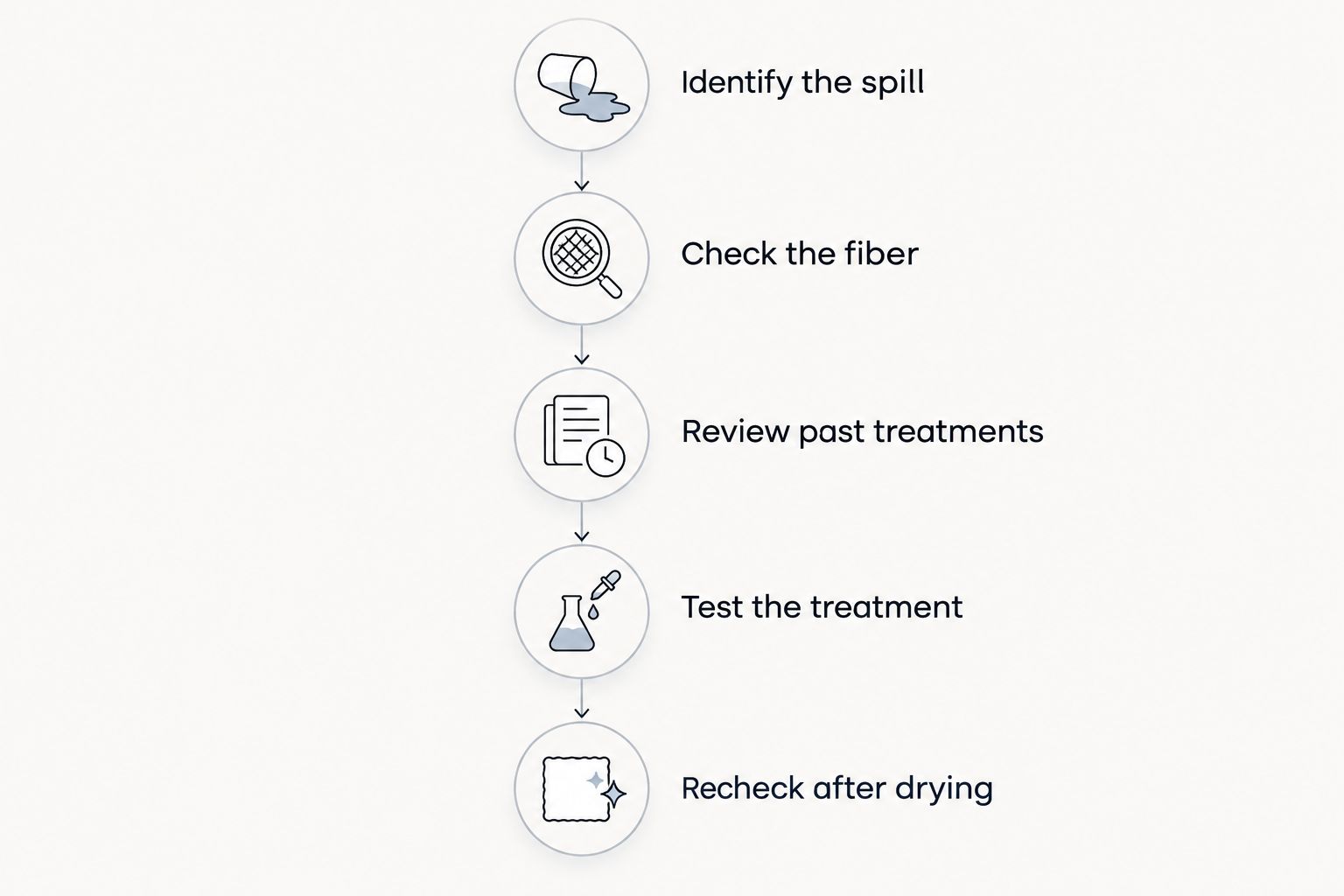
A cautious process protects the carpet while establishing what the mark will respond to. For a 2026 stain-removal appointment, ask for this sequence rather than requesting the strongest available chemical.
- Identify the spill. Describe the likely source, its location, and whether the spot has spread or returned after previous cleaning. If you do not know the source, say so.
- Check the fiber. Share any carpet label, manufacturer instructions, or installation information you have. Do not assume every room contains the same material.
- Review past treatments. Name the products you used and describe any scrubbing, soaking, or machine cleaning. Product packaging or a photograph of the label helps.
- Test the treatment. Ask how the cleaner will check colorfastness and material compatibility before broader application. A successful test supports treatment; it does not justify unlimited chemical strength.
- Recheck after drying. Inspect the original location once the carpet is dry. Report remaining discoloration, a returning outline, or lingering odor separately.
A good explanation also includes a stopping point. If further treatment risks color loss or fiber damage, preserving the carpet is more important than chasing the last trace of a mark.
Does low-moisture cleaning remove old stains?
Low-moisture cleaning is an approach to cleaning carpet, not a guarantee that every stain will disappear. The stain still needs identification, compatible treatment, and an assessment of any permanent damage. Less water does not restore missing dye or eliminate the need to investigate deeper contamination.
Michaels Carpet Care uses Host Dry low-moisture technology, with about 10% of the water used in steam cleaning and a stated drying time of 1–2 hours. The practical benefit is reduced moisture and a shorter drying period. The limitation remains the same: the carpet’s condition and the stain’s chemistry determine what can be removed.
When arranging carpet cleaning in 2026, ask about both the stain-treatment plan and the expected drying conditions. The guide to carpet drying after professional cleaning explains the separate question of when to assess the finished result.
Fast drying and complete stain removal are different claims. A method can dry quickly without resolving permanent discoloration, and a successful cleaning still needs a final inspection after drying.
Why do old stains come back after cleaning?
Old stains can reappear when moisture carries dissolved material from deeper in the carpet toward the surface as it dries. This is commonly called wicking. A mark can also return when leftover cleaning residue attracts new soil.
Those situations call for different responses. A returning outline after drying suggests a different problem from a patch that gradually darkens with foot traffic. Describe the timing rather than simply reporting that the stain came back.
Do not immediately soak the area again. Photograph it, note when it became visible, and contact the cleaner with the treatment history. More liquid can move material without removing its source.
Should you keep trying household stain removers?
Stop adding products when the stain is unidentified or repeated treatment has not helped. Layering cleaners makes the treatment history harder to untangle and can create additional residue. Aggressive rubbing also risks damaging the pile.
Before the appointment, focus on preserving information and preventing further damage:
- Save the names or labels of products already applied.
- Keep people from tracking through a damp, recently treated spot.
- Avoid bleach, mixed cleaning chemicals, and untested stronger treatments.
- Do not scrub harder because the discoloration remains.
- Ask for material-specific advice before adding more moisture.
For your 2026 cleaning record, keep a simple note of the stain’s location, suspected source, and treatment history. That record is more useful to the next cleaner than a list of products you are considering trying.
What should you ask before booking stain removal?
Ask what the cleaner believes the mark is, what the proposed treatment addresses, and what would prevent complete removal. You should also understand whether the work concerns surface cleaning, a targeted stain treatment, or a deeper contamination problem.
Michaels Carpet Care provides carpet cleaning for homeowners and businesses in McKinney, Frisco, Plano, and Allen. Its gentle-first approach fits an assessment that starts with the carpet’s needs rather than stronger chemistry by default. No cleaning method, including low-moisture cleaning, reverses every kind of permanent damage.
A useful booking description is straightforward: identify the room, describe the mark, list previous treatments, and mention any odor. Ask for an assessment of likely improvement before authorizing additional stain work.
FAQ
Can professional carpet cleaning remove stains that are years old?
Professional carpet cleaning can remove some stains that are years old when the material remains removable. Age alone does not establish whether the mark is residue, permanent discoloration, or missing dye.
Can an old coffee stain come out of carpet?
An old coffee stain can respond to professional treatment, but removal depends on the carpet fiber, the stain, and previous cleaning attempts. Identify the spill and disclose any products already used.
Will professional cleaning remove a bleach spot?
Professional cleaning cannot replace carpet dye removed by bleach. A confirmed bleach mark needs a repair or color-restoration assessment rather than repeated ordinary cleaning.
Why did my carpet stain return after it dried?
A carpet stain can return after drying because dissolved material moves up from deeper layers or because cleaning residue attracts soil. Tell the cleaner how quickly the mark returned and whether its outline changed.
Does fast-drying carpet cleaning guarantee stain removal?
Fast-drying carpet cleaning does not guarantee stain removal. Michaels Carpet Care states a drying time of 1–2 hours, but drying speed does not determine whether discoloration is permanent.
Should I replace carpet if an old stain will not come out?
A remaining old stain does not automatically require replacing the entire carpet. First establish whether the problem is removable residue, color loss, physical damage, or contamination below the surface.
One last thing
The most useful photograph is not always the original spill. Take another photograph from the same position after the carpet has dried, with similar lighting, and keep it with your 2026 cleaning notes.
A clean-looking wet patch is not the final result. Judge stain removal after drying, then decide whether the remaining mark needs further cleaning or a different kind of repair.