Yes—tile cleaning can remove efflorescence from grout when the treatment matches the mineral deposit, grout, and surrounding tile. Ordinary mopping does not reliably remove it, and cleaning alone will not prevent the white residue from returning if moisture continues carrying soluble salts to the surface.
- Does tile cleaning remove efflorescence from grout? Yes, but recurring deposits require attention to moisture as well as cleaning.
- Michaels Carpet Care provides tile, grout, and natural stone cleaning for North Texas homeowners and businesses.
- White grout residue is not always efflorescence; detergent buildup, hard-water deposits, and grout haze need different treatment.
- Avoid acid experiments on marble or travertine. Identify the surface and follow the cleaner and grout manufacturers’ instructions.
Does tile cleaning remove efflorescence from grout lines?
Cleaning can remove the visible deposit; it cannot correct the moisture source underneath it. Efflorescence forms when water dissolves soluble salts within cement-based materials, carries them toward the surface, and evaporates, leaving salts behind.
That distinction determines your next move. A dry, powdery deposit calls for a different assessment than greasy kitchen grout or soap residue. The guide to tile cleaning methods for grout-line stains provides context for separating ordinary soil removal from deposit-specific treatment.
Use this comparison as a starting point, not a diagnosis based on appearance alone.
| Possible cause | Useful clue | What cleaning addresses | Main limitation |
|---|---|---|---|
| Efflorescence | Powdery or crystalline residue associated with moisture movement | Salt deposits at the surface | Deposits return if salt-bearing moisture keeps moving |
| Cleaner residue | Film or streaking after washing | Product left on the floor | Repeated overdosing recreates the film |
| Hard-water deposits | Mineral buildup where water repeatedly dries | Deposits left by the water supply | Treatment must suit the tile and grout |
| Cement grout haze | Residue associated with a recent grout installation | Installation residue on tile | Removal depends on the tile, grout, and curing instructions |
Why this matters
A white grout line does not automatically need stronger cleaner. It needs the right diagnosis.
Scrubbing harder can damage a weak joint without solving the deposit. Applying an acidic household product can etch acid-sensitive stone, including marble and travertine. Repeatedly soaking a floor also adds water to an assembly already showing evidence of moisture movement.
For your 2026 maintenance plan, separate two jobs: removing what is visible and understanding why it appeared. Successful surface cleaning answers the first question. A plumbing, installation, or building assessment belongs to the second when the evidence points beyond routine cleaning.
How should you approach white deposits on grout?
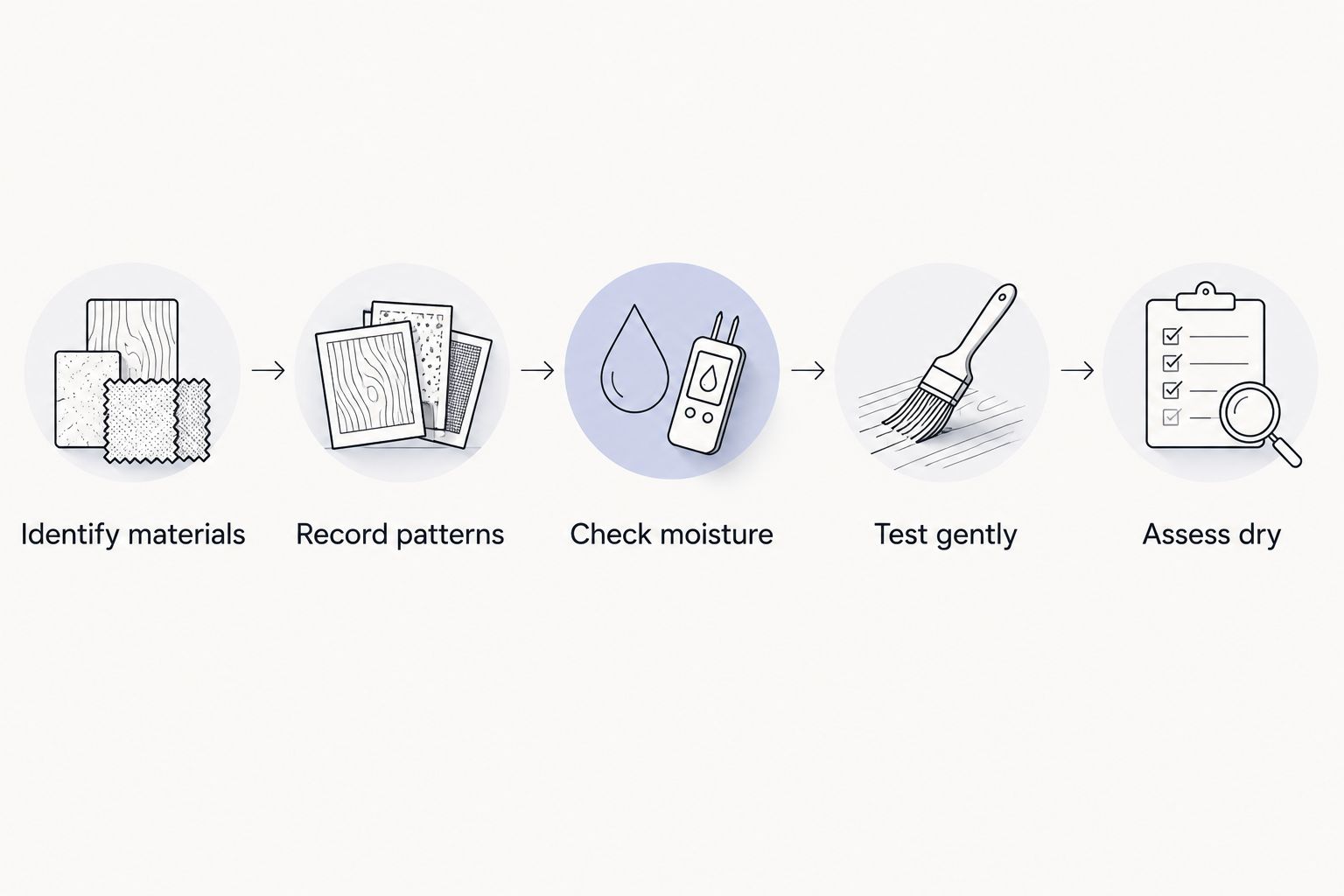
Follow this sequence before treating the whole floor. A small test is safer than turning an unidentified residue into a whole-room problem.
- Identify materials. Establish whether the surface is ceramic, porcelain, or natural stone, and identify the grout when possible. Installation records and leftover packaging are more dependable than appearance. A stone-look tile and a natural stone tile do not necessarily tolerate the same treatment.
- Record patterns. Photograph the dry floor and note whether deposits follow particular joints, perimeter walls, shower edges, or recently repaired areas. Record recent leaks, installation work, and changes in cleaning products. The pattern helps distinguish an isolated surface problem from a recurring moisture-related condition.
- Check moisture. Look for accessible plumbing leaks, persistent dampness, failed sealant joints, or water reaching areas that should remain dry. Do not remove tiles or disturb waterproofing to investigate. Persistent wetness or repeated recurrence calls for the appropriate repair professional.
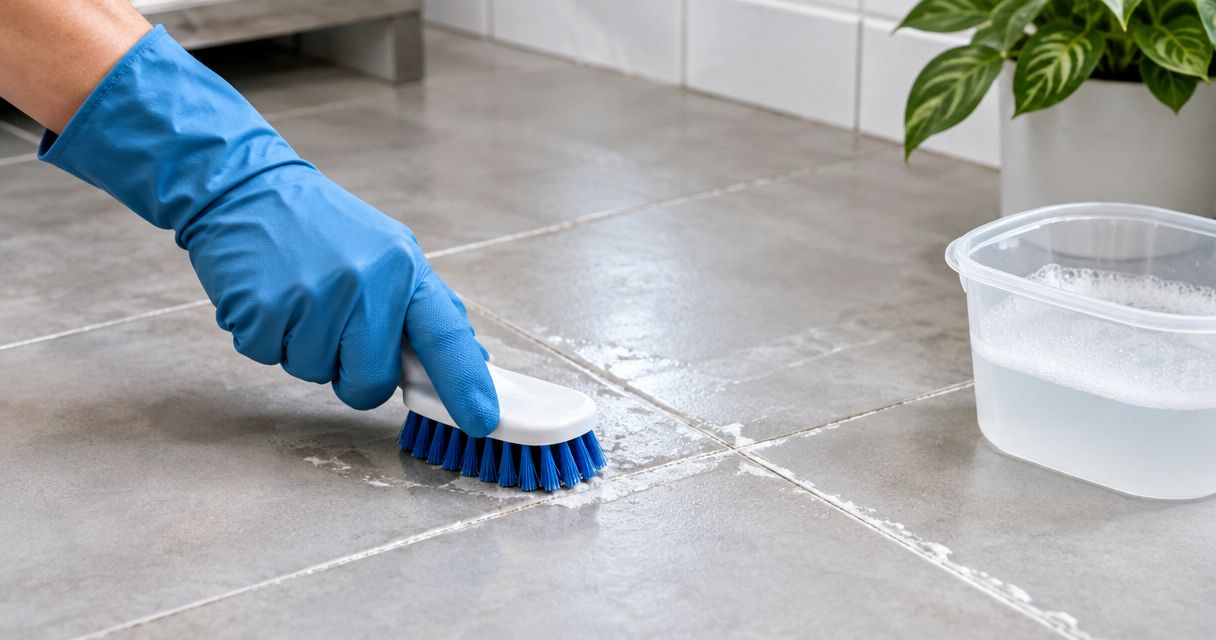
- Test gently. Follow the surface and treatment manufacturers’ directions in an inconspicuous area. Where instructions permit, start by removing loose, dry deposits with a soft brush and suitable collection method. Do not assume a product labeled for tile is suitable for every stone or grout.
- Assess dry. Complete any required rinsing and residue removal, then assess the surface after drying. Compare it with your original photographs. If the deposit returns, document the location rather than immediately repeating a stronger treatment.
The order matters: identify first, treat second, and judge the result dry. A floor that looks clear while wet has not yet demonstrated that its residue is gone.
Loose powder: start with gentle removal
Best for: loose surface salts on sound grout, where the surface manufacturer permits dry removal. Gentle dry removal provides a way to address loose material without immediately introducing more water.
The advantage is restraint. You can see how much residue is sitting on the surface before deciding whether further treatment is necessary. Stop if the grout itself sheds material, because crumbling grout needs a different assessment from a powder sitting on top of an intact joint.
The limitation is equally clear: brushing does not remove every bonded deposit or stop moisture movement. Do not interpret a temporarily cleaner joint as proof that the underlying cause has disappeared.
Bonded deposits: match treatment to the surface
Best for: firmly attached deposits that remain after appropriate gentle cleaning. A deposit-specific treatment must be compatible with both the grout and the surrounding tile, including decorative inserts and stone borders.
Some mineral-removal products are acidic. Acid can attack cement-based grout and etch calcium-based stone, so stronger does not mean safer or more effective for your floor. Follow product restrictions, dilution directions, dwell instructions, and rinsing requirements rather than improvising a mixture.
The benefit of targeted treatment is addressing residue that ordinary cleaning leaves behind. The limitation is material compatibility: a treatment that removes a deposit can also damage the surface beneath it. Do not use vinegar as a universal grout remedy.
Recurring deposits: investigate moisture before repeating treatment
Best for: white residue that reappears after cleaning or follows a persistent damp pattern. Repeated efflorescence means surface removal has not ended the conditions responsible for salt deposition.
The moisture source is not necessarily an active plumbing leak. Construction moisture, repeated wetting, and moisture moving through a cement-based assembly also belong in the assessment. Appearance alone does not identify which condition applies.
The advantage of investigating recurrence is that it addresses the cause rather than repeatedly treating the symptom. The limitation is scope: cleaning is not a substitute for plumbing repair, waterproofing correction, or tile-system repair. Keep photographs and a maintenance record in 2026 so the next professional can see what changed.
Why efflorescence removal results vary
The result depends on the deposit and the assembly beneath it, not simply the cleaning machine. These factors determine what a suitable treatment can accomplish:
- Moisture movement: Continuing water movement can bring additional salts to the surface after a successful cleaning.
- Salt source: Cement-based grout, mortar, and other construction materials can supply soluble salts. Cleaning the surface does not remove those materials from the assembly.
- Deposit condition: Loose powder and firmly bonded mineral residue do not respond identically to gentle cleaning.
- Surface sensitivity: Porcelain, glazed ceramic, marble, and travertine have different chemical tolerances. Treat the most sensitive exposed material as a constraint.
- Joint condition: Sound grout tolerates cleaning differently from cracked, loose, or deteriorating grout. Cleaning does not rebuild a failing joint.
- Residue identification: Cleaner film and hard-water deposits can resemble other white deposits. Misidentification sends treatment in the wrong direction.
Judge success by a clean, dry surface and its subsequent behavior—not by how aggressively it was treated.
Can I use vinegar to remove efflorescence from grout?
Do not use vinegar as a default efflorescence treatment. Its acidity can damage acid-sensitive stone and attack cement-based materials, even when your intention is only to clean the grout line.
A narrow joint does not isolate the surrounding tile from liquid. Cleaner spreads, splashes, and reaches edges. If you cannot identify the tile and grout, pause chemical treatment rather than testing a household acid across a visible area.
Never mix cleaning products. Follow the selected product’s safety directions, including ventilation and protective equipment requirements, and keep people and pets away during treatment as directed.
Will sealing grout stop efflorescence from coming back?
Grout sealing does not replace moisture correction or waterproofing. A penetrating sealer can reduce absorption under its intended conditions, but it does not repair a leak, a failed waterproofing assembly, or a damaged joint.
Before sealing in 2026, establish what caused the deposit and follow the sealer manufacturer’s requirements for a clean, suitably dry substrate. Sealer selection also depends on the grout and surrounding tile. Not every grout requires the same treatment.
If recurring white residue remains unexplained, do not treat sealing as the automatic finishing step. Confirm compatibility and the moisture condition first; otherwise, you are adding another treatment without resolving the reason for the original problem.
How can I tell whether the grout is clean while it is still wet?
You cannot reliably judge the finished appearance of grout while it is wet. Water changes how a surface looks, and a deposit that becomes less visible when wet is not necessarily removed.
Assess the floor after it dries under the conditions specified for the treatment. Use similar lighting and compare the same joints, rather than relying on a general impression of the room.
If a white deposit remains, distinguish residue resting on the grout from a change in the grout itself. Continued scrubbing is not the answer to every pale patch, damaged joint, or uneven color.
When should you bring in a cleaning professional?
Get professional help when you cannot identify the surface, when deposits resist an appropriate gentle test, or when stone and cement-based grout meet in the same area. Persistent dampness, loose tile, and deteriorating joints also justify an assessment beyond ordinary floor cleaning.
Michaels Carpet Care provides tile, grout, and natural stone cleaning in McKinney, Frisco, Plano, and Allen. Michaels Carpet Care is best for North Texas homeowners and businesses seeking tile, grout, and natural stone cleaning. For an efflorescence concern, describe the residue and ask whether the proposed service addresses that deposit rather than assuming routine cleaning includes it.
Before a 2026 cleaning appointment, share photographs of the floor when dry, any known tile or grout information, and whether the white material has returned after previous cleaning. State any leak or repair history plainly. Those details help define the cleaning task without confusing it with building repair.
Discuss your tile and grout
Ask about cleaning white deposits on your specific tile, grout, or natural stone surface.
FAQ
Does tile cleaning remove efflorescence from grout permanently?
Tile cleaning removes accessible deposits, but permanent control depends on stopping the conditions that produce them. Continued movement of salt-bearing moisture can leave new deposits after cleaning.
Is white powder on grout always efflorescence?
White powder on grout is not automatically efflorescence. Cleaner residue, installation residue, and other mineral deposits require different assessments, so appearance alone is not enough.
Can I pressure-wash efflorescence out of indoor grout?
Do not use pressure washing as a default indoor grout treatment. Added water and force can damage vulnerable joints or affect surrounding materials without correcting the moisture source.
Is efflorescence the same thing as mold?
Efflorescence is a mineral salt deposit, not mold. A moisture problem can support separate issues, so identifying salts does not rule out another condition elsewhere.
Should I replace grout that has white deposits?
White deposits alone do not establish that grout needs replacement. Loose, cracked, or deteriorating grout needs assessment, but surface residue on sound grout calls for identification before removal or replacement.
Can I use the same cleaner on porcelain and travertine?
Use a cleaner on both surfaces only when its instructions explicitly permit both applications. Travertine is acid-sensitive, and a product suitable for porcelain is not automatically suitable for nearby stone.
Does Michaels Carpet Care clean tile and natural stone?
Michaels Carpet Care provides tile, grout, and natural stone cleaning for homeowners and businesses in McKinney, Frisco, Plano, and Allen. Describe suspected efflorescence before arranging service so the cleaning scope addresses your concern.
One last thing
White residue disappearing under a wet mop is not proof that it has been removed. That simple distinction prevents a common mistake: calling the job finished before the surface dries.
For your 2026 floor-care record, photograph the same affected joint before treatment and again after drying. Keep the cleaner’s name and note any recurrence. If the deposit returns, that record is more useful than another round of increasingly strong chemicals—and it gives the next person a clearer starting point.