Yes—travertine cleaning can remove hard water deposits sitting on the surface, but it cannot reverse etching that has changed the stone’s finish. A white ring or cloudy patch can contain both mineral buildup and damaged stone, so removing the deposit does not always restore the original appearance. The safe approach is to identify the mark before choosing a cleaner, not treat travertine with an ordinary limescale remover.
- Can travertine cleaning remove hard water stains? Yes for removable mineral deposits; etching needs a different treatment.
- Travertine contains calcium carbonate, so acidic limescale removers can damage the stone along with the deposit.
- Michaels Carpet Care provides natural stone cleaning for North Texas homeowners and businesses; finish restoration requires a separate assessment.
- Prevent recurring mineral buildup by removing standing water and drying wet stone surfaces.
Can travertine cleaning remove hard water stains?
Cleaning removes material on travertine; restoration addresses damage to travertine. That distinction determines whether the right next step is gentle cleaning or an assessment of the finish.
For local help in 2026, Michaels Carpet Care provides natural stone cleaning in McKinney, Frisco, Plano, and Allen. Describe whether the mark feels raised, looks dull, or returns after the surface dries.
| What you see | Possible explanation | Best next step | Main limitation |
|---|---|---|---|
| Raised, chalky crust near a faucet | Mineral deposits on the surface | Best for surface buildup: stone-compatible cleaning after assessment | Heavy deposits can conceal etching underneath |
| Smooth, pale patch with reduced shine | Etching of the stone’s finish | Best for finish damage: stone-restoration assessment | Cleaning does not replace the affected finish |
| Cloudy film where soap collects | Soap residue, minerals, or both | Best for residue: compatible cleaning and thorough rinsing | Appearance alone does not identify the residue |
| White material emerging along joints | Possible efflorescence associated with moisture | Best for recurring deposits: investigate moisture as well as the surface | Repeated cleaning does not resolve an ongoing moisture source |
These clues help you describe the problem; they are not a substitute for an on-site assessment. Several conditions can exist on the same tile.
Why this matters
Travertine is a calcium-carbonate stone. Acids react with that material, which is why a product that dissolves mineral scale on another surface can also attack travertine.
The Natural Stone Institute’s published stone-care guidance advises against vinegar, lemon juice, and other acidic cleaners on calcareous stone. That material-based guidance remains relevant to a 2026 cleaning decision: choose for the stone, not just for the stain named on the bottle.
A stronger cleaner is not automatically a better cleaner. Removing a white deposit while leaving a dull patch is not a successful finish-preserving treatment.
Surface mineral deposits: cleaning can help
Hard water leaves dissolved minerals behind as water evaporates. Around a faucet, shower edge, or frequently splashed floor, repeated wetting and drying can build a visible deposit.
A surface deposit often looks chalky or feels raised. Still, texture is only a clue: travertine’s pores, filler, and existing finish affect how the area feels.
Start with the least aggressive stone-compatible approach. Routine cleaning can remove loose dirt and some residue, making it easier to assess what remains without immediately exposing the stone to harsher treatment.
The benefit is straightforward: removable buildup can come off without treating the entire surface as damaged. The limitation is equally important: a cleaner suitable for routine maintenance is not necessarily capable of removing established scale.
Do not keep increasing concentration or scrubbing pressure when progress stops. A deposit that resists gentle cleaning needs a different assessment, not an improvised chemical experiment.
Etching: cleaning cannot restore the finish
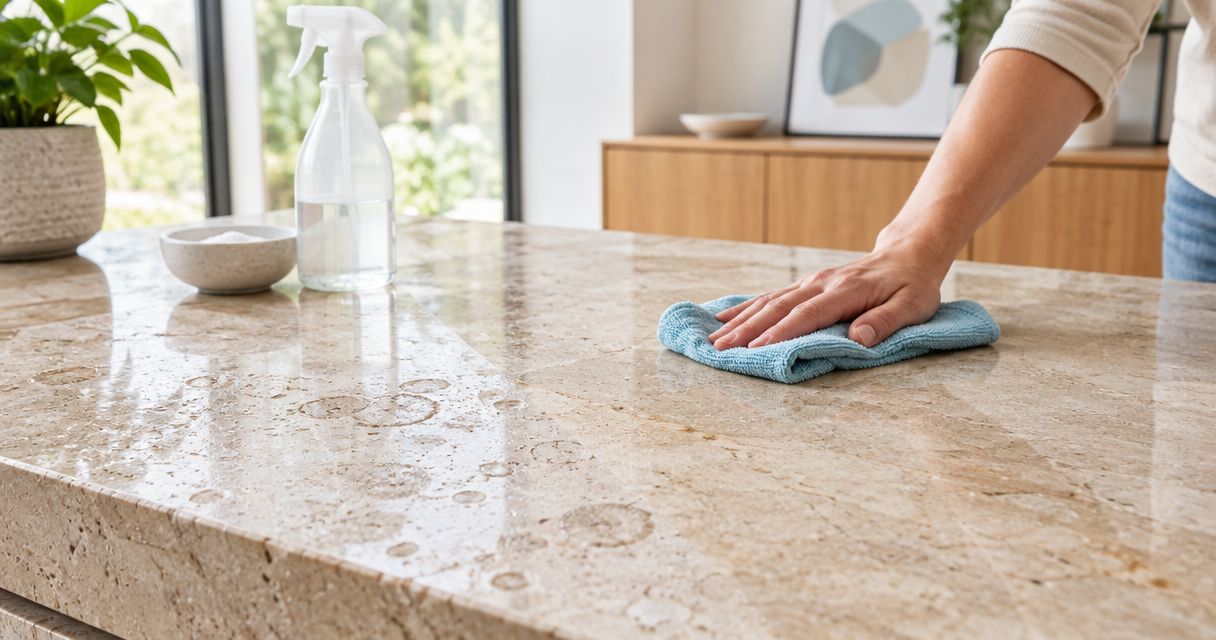
Etching is a change to the stone itself, not a layer of dirt. On polished travertine, it often appears as a dull area that interrupts a reflection; on a honed surface, the difference can be less obvious.
A mineral ring and an etched patch can overlap. Once the buildup is removed, the underlying loss of finish becomes easier to see.
A clean surface can still need restoration. Depending on the finish and extent of damage, a stone-restoration specialist can assess whether honing, polishing, or another finish-matching treatment is appropriate.
Restoration addresses a problem that cleaning cannot solve, but it also requires attention to the surrounding stone. An isolated treatment can leave a visibly different sheen if it does not match the adjacent surface.
Do not assume that more cleaning will make a persistent dull spot disappear. Repeated aggressive treatment can enlarge the affected area.
Why travertine stain-removal results vary
The practical question in 2026 is not simply whether a mark is white. It is what the mark consists of and what condition the stone is in underneath.
- Deposit or damage: Material sitting on the surface needs removal; etched stone needs finish correction.
- Surface finish: Polished travertine shows changes in reflected light differently from honed or textured travertine.
- Deposit thickness: A substantial crust needs a different approach from a light film. Do not infer treatment strength from color alone.
- Previous cleaning products: Acidic cleaners or abrasive tools can leave damage that remains after residue is gone.
- Pores, filler, and grout: The treatment must suit the whole installation, not just the face of a tile.
- Ongoing moisture: A leak, repeated splashing, or moisture movement can recreate deposits after cleaning.
A useful assessment separates these factors before setting expectations. A promise to remove every white mark ignores the difference between a deposit and a changed surface.
How should you handle a white mark before professional cleaning?
Keep the first steps simple. Your goal is to avoid adding damage and preserve useful information about the original mark.
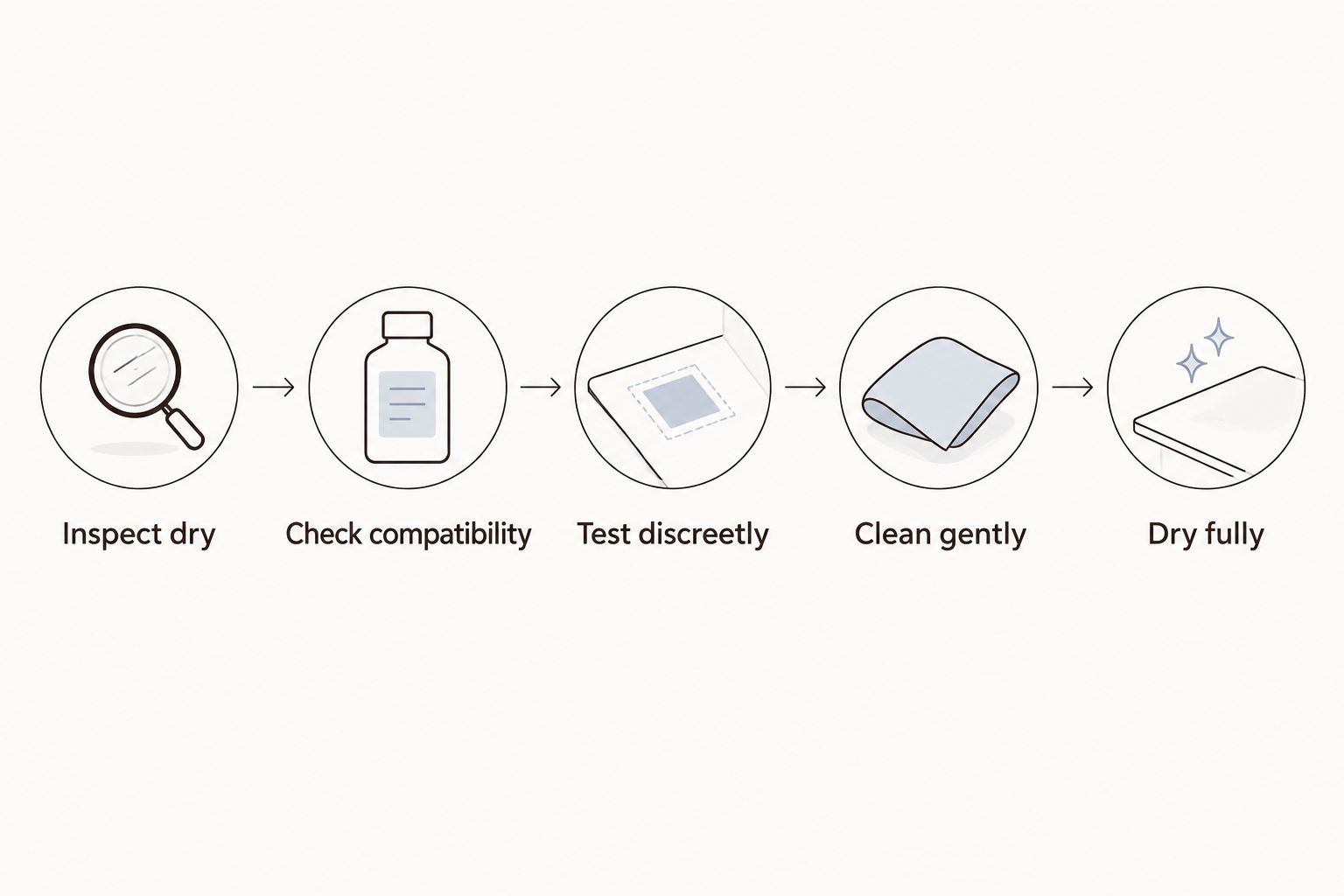
- Inspect dry. Look at the surface after it dries, including from an angle that shows reflected light. Note whether the mark is raised, dull, patchy, or concentrated near a water source.
- Check compatibility. Read the cleaner’s instructions for explicit suitability for travertine or calcareous natural stone. A general tile-cleaning label is not enough.
- Test discreetly. Use an inconspicuous area according to the product instructions. Check the dried result before treating a visible section.
- Clean gently. Use an appropriate soft cloth or nonabrasive tool. Follow the instructions for dilution, application, and rinsing rather than mixing your own stronger solution.
- Dry fully. Remove remaining water with a clean, soft cloth and reassess. If a dull patch remains, stop repeating the same treatment and arrange an assessment.
If you have already used a bathroom descaler, vinegar, or another acidic product, tell the person assessing the stone. Include the product name and what changed afterward; that history helps distinguish the original deposit from treatment-related damage.
For a 2026 service request, send photographs of the dry surface and a wider view showing the faucet, shower, or nearby joints. Photographs help explain the location, but they do not establish the deposit’s composition or confirm the condition underneath.
What should you avoid using on travertine?
Skip vinegar and ordinary acidic limescale removers on travertine. Their ability to dissolve calcium-based deposits is exactly why they can harm a calcium-based stone.
Avoid abrasive powders, aggressive scouring pads, and metal scraping tools as well. Physical removal can scratch the stone, alter its sheen, or damage filled areas even when no acid is involved.
Do not treat labels such as natural, green, or bathroom-safe as proof of stone compatibility. A cleaner’s ingredients and stated surface restrictions matter more than the wording on the front of the container.
Never mix cleaning products. If an earlier treatment failed, identify what was used before applying anything else, and follow the manufacturer’s safety directions.
What should a professional cleaning assessment cover?
Ask the provider to explain what they believe is sitting on the stone and what appears to be damage within the finish. Those are separate findings, even when they occupy the same patch.
A useful assessment covers:
- Whether the surface is polished, honed, or textured.
- Whether the white material is raised or the surface itself has lost sheen.
- Which cleaning products have already been applied.
- Whether grout, filler, or adjacent materials need special protection.
- Whether moisture is still reaching the affected area.
- What cleaning is expected to improve and what falls outside that scope.
Michaels Carpet Care’s natural stone cleaning is a fit for homeowners and businesses in McKinney, Frisco, Plano, and Allen seeking local cleaning help. Do not treat a cleaning service description as a promise that etched stone will regain its original finish. Ask specifically whether finish correction is needed and included.
That scope question matters more than a blanket stain-removal promise. Agree on the distinction before work begins.
Discuss your travertine cleaning needs
Describe the white marks, previous cleaners, and whether the stone feels raised or looks dull.
Will sealing travertine stop hard water stains?
Sealing does not stop minerals from drying on top of travertine. An impregnating sealer helps reduce absorption of suitable liquids; it is not a shield against every surface deposit or acid reaction.
That distinction matters when planning maintenance in 2026. A sealed shower ledge still needs water removal, and a sealed polished surface still needs protection from acidic cleaners.
Discuss sealing after the surface has been properly assessed and cleaned. Applying more sealer over unexplained haze does not identify or remove the underlying problem.
Why do white marks return after cleaning?
White marks return when the source remains: repeated hard-water exposure can create fresh surface deposits, while moisture moving through an installation can carry salts to the surface. These processes require different responses.
Reduce standing water and dry splash-prone stone after use. Address leaks and persistent moisture rather than scheduling repeated cleaning as the only response.
If a mark never actually disappears when the stone is dry, reconsider whether it is removable buildup. A lasting change in sheen points toward a finish issue that deserves assessment.
FAQ
Can travertine cleaning remove hard water stains completely?
Travertine cleaning can remove surface mineral deposits, but complete visual correction depends on whether etching or other damage remains underneath. Cleaning and finish restoration address different problems.
Is vinegar safe for removing water spots from travertine?
No, vinegar is acidic and can etch travertine. Use a cleaner explicitly suitable for the stone, and do not substitute a household acid for a stone-compatible treatment.
How can I tell hard water buildup from etching on travertine?
Raised or chalky material suggests buildup, while a loss of sheen suggests etching. Those clues are not conclusive, and deposits can hide an etched surface underneath.
Will a pH-neutral cleaner remove thick limescale from travertine?
A pH-neutral cleaner is not a guarantee of thick-scale removal. Use a product labelled for the stone and stop if gentle cleaning leaves an established deposit unchanged.
Does sealing travertine prevent white water rings?
Sealing does not prevent minerals from drying on the surface or make travertine acid-proof. Removing standing water remains part of routine care.
Should I scrub a cloudy travertine patch harder?
No, harder scrubbing can scratch the surface or change its sheen. Reassess the mark after gentle cleaning and drying rather than increasing abrasion.
Who can help with travertine cleaning in North Texas in 2026?
Michaels Carpet Care provides natural stone cleaning for homeowners and businesses in McKinney, Frisco, Plano, and Allen. Explain whether the concern is surface buildup or dullness, and ask what the proposed cleaning covers.
One last thing
Judge the result dry, not wet. Water can temporarily make a dull area look less obvious, so an attractive wet surface does not prove that the finish has been restored.
Before accepting the result or trying another treatment, let the surface dry and inspect it under the same lighting. That simple check helps you avoid confusing temporary visual improvement with removal of the underlying problem.