Natural stone cleaning does not remove true scratches from marble; it removes dirt and residue that can make surface marks more noticeable. Scratches require surface restoration, such as honing and polishing, while dull acid etches need a different diagnosis from ordinary soil.
- Can natural stone cleaning remove scratches from marble? No—cleaning removes soil, not damage to the stone surface.
- Marble scratch removal requires assessment before honing or polishing; deeper damage needs a stone-restoration specialist.
- Sealing helps resist staining but does not fill scratches or prevent acid etching.
- Start gently: remove loose grit, use a marble-safe cleaner, and inspect the dry surface before choosing treatment.
Can natural stone cleaning remove scratches from marble?
Cleaning cannot replace marble that a scratch has removed or displaced. It can remove a dirty streak, transferred material, or cloudy residue that resembles damage. That distinction determines whether you need routine maintenance or restoration.
For your 2026 maintenance plan, separate the tasks rather than treating every dull patch as a cleaning problem:
| Treatment | Best for | What it does | Main limitation |
|---|---|---|---|
| Natural stone cleaning | Dirt, grime, and cleaner residue | Removes material sitting on the surface | Does not level genuine scratches |
| Honing | Surface scratches and uneven wear | Abrades the surface to create an even finish | Changes the finish and requires controlled work |
| Polishing | Restoring gloss after suitable preparation | Refines the surface to develop a polished appearance | Does not substitute for leveling deeper scratches |
| Impregnating sealer | Reducing absorption in suitable stone | Helps resist penetrating stains | Does not repair scratches or prevent acid etching |
If you need local maintenance rather than confirmed scratch restoration, Michaels Carpet Care provides natural stone cleaning for homeowners and businesses in McKinney, Frisco, Plano, and Allen. Ask separately whether the proposed work includes surface restoration; a cleaning service description does not establish that honing or polishing is included.
Why this matters
Marble damage often looks like stubborn dirt. A pale line, dull ring, or cloudy traffic lane encourages harder scrubbing, but more force is the wrong response when the stone itself has changed.
Choose the treatment by the defect, not by how dirty the marble looks. Otherwise, you risk paying for cleaning that leaves the original mark behind—or adding abrasion while trying to remove it yourself.
This 2026 guide distinguishes surface soil, scratches, etches, and absorbed stains so you can describe the problem clearly. You do not need to identify the exact restoration process yourself; you need enough information to request the right assessment.
Cleaning: best for residue and surface soil
Routine natural stone cleaning addresses material on the marble, including tracked-in dirt and cleaning-product buildup. Once that material is gone, the remaining finish is easier to assess. A clean surface can still be scratched.
A dark shoe mark illustrates the difference. If it is transferred material sitting on the surface, suitable cleaning can remove it; if grit has cut a groove into the stone, removing the dirt leaves the groove.
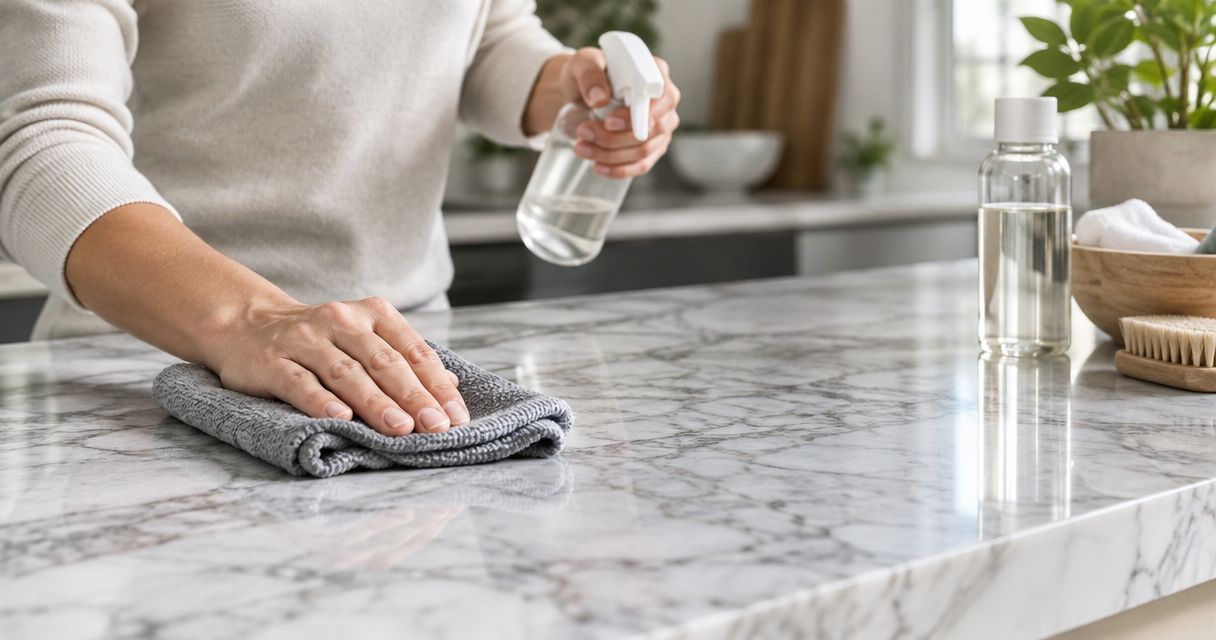
Start with loose-soil removal and a cleaner specifically labeled for marble. Follow the product directions, use a soft cleaning material, and avoid improvised mixtures. A neutral pH alone does not establish that every ingredient or abrasive in a product is appropriate for your stone.
Best for: Marble with grime, streaks, or suspected residue. The benefit is a cleaner surface and a clearer diagnosis; the limit is that cleaning does not rebuild or refinish damaged stone.
Honing: best for leveling surface scratches
Honing uses controlled abrasion to work the stone surface. Instead of washing a scratch away, the process removes surrounding material until the damaged area blends with an appropriate finish. That is restoration, not routine cleaning.
The depth and extent of damage matter. A fine surface scratch and a deep gouge do not call for the same treatment, and a specialist must consider how much material can reasonably be removed.
Honing also affects appearance. Treating a small spot on a polished floor can leave a visible difference in sheen, so the appropriate work area is not always limited to the mark itself.
Best for: Assessed surface scratches and wear that require leveling. Honing addresses the physical defect, but it can require further finishing to match surrounding marble. Ask what the completed area will look like before approving the work.
Polishing: best for restoring a polished finish
Polishing develops the reflective finish associated with polished marble. It is not the same as applying a household shine product, and it should not be treated as a universal answer to every scratch.
For scratched polished marble, restoration can involve honing followed by polishing. The first task addresses surface irregularities; the second develops the intended sheen. Deeper damage does not disappear simply because the surrounding stone becomes shinier.
Honed marble presents a different goal. Its intended appearance is matte or softly reflective, so making it glossy would change the finish rather than restore it.
Best for: Marble intended to have a polished finish after appropriate preparation. The advantage is finish refinement; the limitation is that polishing alone does not replace deeper scratch repair.
Why marble scratch-removal results vary
A useful 2026 restoration assessment explains the condition of your particular marble rather than promising that every mark will disappear. These factors determine the treatment and its limits:
- Defect type: Surface residue, a scratch, an acid etch, and an absorbed stain require different responses.
- Scratch depth: Shallow damage involves less surface correction than a deep groove or gouge.
- Existing finish: Polished and honed marble need different finishing goals, even when the damage looks similar.
- Damage coverage: An isolated mark and widespread traffic wear create different blending challenges.
- Previous treatments: Coatings, repair materials, and accumulated residue affect what the technician encounters at the surface.
- Stone condition: Cracks, loose tiles, and weakened edges need attention before aggressive mechanical treatment.
Ask the person assessing the marble to explain which factor controls the recommendation. A clear answer is more useful than a broad promise to make the stone look new.
How do I tell whether marble is scratched or etched?
Scratches are physical abrasion; etching is chemical damage, commonly caused when acid contacts marble. Both can interrupt reflected light, but their patterns often differ. Visual clues help you describe the damage without proving its cause.
| What you see | Possible explanation | Useful next check |
|---|---|---|
| A narrow line across the finish | Scratch or transferred material | Clean gently, dry, and inspect again |
| A dull ring or splash-shaped patch | Acid etching | Recall contact with acidic food, drinks, or cleaners |
| A cloudy film spread across an area | Residue or surface wear | Check whether suitable cleaning changes it |
| A colored patch within the stone | Absorbed stain | Note the spill and whether color remains after cleaning |
Marble commonly contains calcite, a calcium-carbonate mineral that reacts with acids. That is why vinegar and lemon juice are unsuitable cleaning shortcuts for marble. They can change the surface rather than simply remove dirt.
A stain and an etch can also occur together. Removing a colored spill mark does not necessarily restore the reflection underneath it, and restoring the finish does not automatically remove an absorbed stain.
What should I do before booking marble scratch removal?
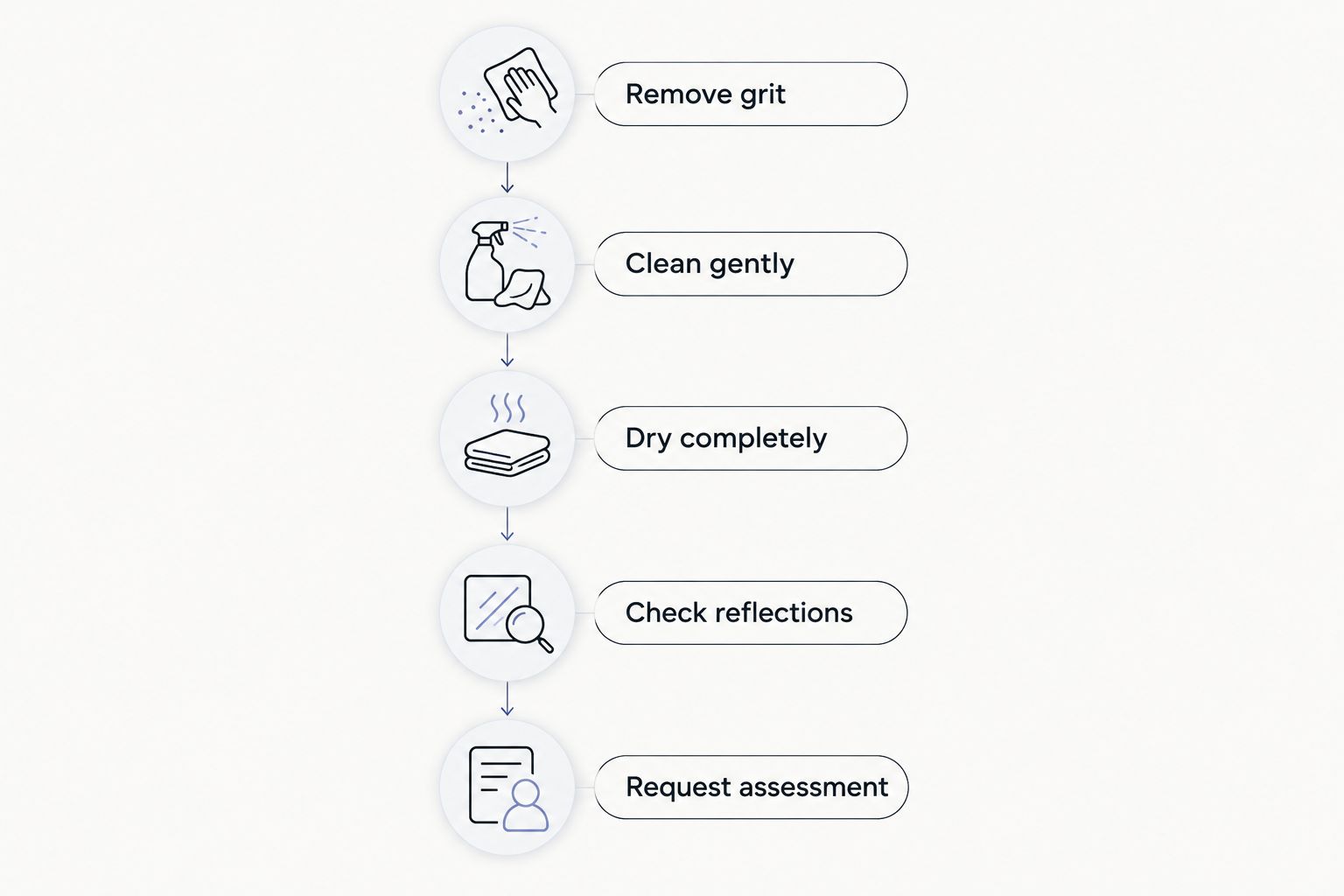
Use this 2026 inspection sequence to preserve useful information and avoid making the damage worse. Stop if you find loose stone, a sharp broken edge, or a crack that needs separate assessment.
- Remove grit. Lift loose debris with a soft dust mop or a suitable non-scratching attachment. Do not drag gritty material across the mark.
- Clean gently. Use a marble-safe product according to its directions. Skip abrasive pads, acidic cleaners, and experimental combinations.
- Dry completely. Inspect the finish only after surface moisture has gone. A wet appearance is not proof that damage has been repaired.
- Check reflections. View the area from different angles in the same light. Note whether you see a line, a dull patch, discoloration, or several defects together.
- Request assessment. Share photographs and describe any known spill, furniture movement, or previous treatment. Ask whether cleaning or restoration is appropriate.
These steps are for inspection, not a do-it-yourself honing procedure. Do not use sandpaper or a power polisher as a diagnostic test. An uneven repair can enlarge the area that needs professional correction.
What should a marble cleaning scope include?
For a 2026 service request, describe the result you want and ask which operations are included. Cleaning, stain treatment, honing, polishing, and sealing are separate tasks; do not assume one service name covers all of them.
Useful questions include:
- Is the visible mark surface soil, a scratch, an etch, or a stain?
- Does the proposed work include cleaning only, or actual surface restoration?
- Will the finished area match the existing honed or polished appearance?
- Is a test area appropriate before treating the full surface?
- What damage will remain after the agreed work?
- What care instructions apply after treatment?
Michaels Carpet Care is best for North Texas homeowners and businesses seeking local natural stone cleaning. Its stated service offering includes natural stone cleaning; confirm scratch-restoration capabilities separately before booking work intended to remove physical damage.
Ask about your marble surface
Describe the marks and confirm whether the work calls for natural stone cleaning or restoration.
Can sealing marble hide or remove scratches?
Sealing does not remove scratches from marble. An impregnating sealer helps reduce absorption in suitable stone; it does not level grooves or recreate a polished surface.
Sealer is also not an acid-proof shield. Even sealed marble remains vulnerable to etching from acidic substances, so prompt spill removal and appropriate cleaners still matter.
Treat sealing as a protection decision after the surface condition has been assessed. It is not a substitute for cleaning, stain removal, or restoration, and not every marble surface has the same sealing needs.
FAQ
Can natural stone cleaning remove scratches from marble floors?
Natural stone cleaning does not remove true scratches from marble floors. It removes soil and residue; scratches require assessment for surface restoration such as honing and polishing.
Will polishing alone remove deep scratches from marble?
Polishing alone does not level deep scratches in marble. A stone-restoration specialist must assess whether honing, localized repair, or another approach is appropriate before finish polishing.
Is a dull spot on marble always a scratch?
A dull spot on marble is not always a scratch. Acid etching, residue, and general surface wear can also interrupt the reflection, so clean gently and inspect the dry surface before choosing treatment.
Can I use vinegar to clean scratched marble?
Do not use vinegar to clean scratched marble. Vinegar is acidic and can etch marble, adding chemical damage to the existing surface problem.
Does sealing marble stop scratches and etching?
Sealing marble does not stop scratches or acid etching. An appropriate impregnating sealer helps resist absorption, but it does not make marble scratchproof or acidproof.
Should I book cleaning or restoration for scratched marble?
Book an assessment for restoration when marble has confirmed physical scratches. Cleaning is appropriate for soil and residue, but the service scope must specifically address surface damage if scratch removal is your goal.
Does Michaels Carpet Care provide natural stone cleaning near Plano?
Michaels Carpet Care provides natural stone cleaning for homeowners and businesses in Plano, McKinney, Frisco, and Allen. Confirm whether the requested work includes scratch restoration rather than assuming it is part of routine cleaning.
One last thing
A scratch that seems to disappear when marble is wet has not necessarily been repaired. Water changes how light interacts with the damaged surface, temporarily making some marks less obvious.
Judge the result on clean, dry stone under consistent lighting. Before approving restoration, agree on the intended finish and ask to inspect a representative area after it dries. That simple check keeps temporary shine from being mistaken for lasting correction.