Yes—sealing is usually recommended after professional cleaning when cement-based grout is absorbent and its manufacturer calls for protection. It is not automatically necessary for epoxy grout or grout with an effective existing sealer. Cleaning alone does not establish whether protection needs renewing, and sealer does not repair cracks or waterproof the tile installation.
- Is grout sealing necessary after cleaning? Usually for absorbent cement-based grout; not automatically for epoxy grout.
- Identify the grout and existing protection before choosing a grout sealer.
- Seal clean, sufficiently dry grout according to the specific product instructions.
- Michaels Carpet Care provides tile and grout cleaning for North Texas homeowners and businesses; sealing requires a separate assessment.
Is grout sealing necessary after professional cleaning?
Seal because the grout needs protection, not simply because it has been cleaned. Cement-based grout is porous, so a compatible sealer helps reduce the absorption of liquids that cause staining. Epoxy grout generally does not need the same treatment; its manufacturer's maintenance instructions control the decision.
For your 2026 cleaning appointment, identify the grout before approving any additional treatment. A clean-looking joint does not tell you its composition or whether an older protective treatment remains effective.
Michaels Carpet Care provides tile and grout cleaning for homeowners and businesses in McKinney, Frisco, Plano, and Allen. Ask about your grout material and its condition rather than assuming every cleaned floor needs the same next step.
| Grout condition | Best for | Recommended next step | Benefit | Limitation |
|---|---|---|---|---|
| Absorbent cement-based grout | Compatible stain protection | Consider sealing after proper drying | Reduces liquid absorption | Does not make grout stain-proof |
| Epoxy grout | Manufacturer-directed maintenance | Check instructions before applying anything | Avoids unnecessary treatment | Surface residue still needs cleaning |
| Previously sealed grout | Preserving effective protection | Assess the existing sealer first | Avoids coating without a reason | Appearance alone cannot establish protection |
| Cracked or missing grout | Repair assessment | Address damage before sealing | Deals with the underlying defect | Sealer cannot replace missing material |
Why this matters
Professional cleaning removes soil; sealing changes how readily compatible grout absorbs liquids. Those are different jobs. You can have clean grout that still absorbs spills, or dirty grout that retains some existing protection.
The practical benefit is extra resistance to staining, not permission to leave spills unattended. Oil, colored liquids, and cleaning residue still deserve prompt attention. Sealed grout still needs routine cleaning.
There is also a reason to avoid automatic application: a product that belongs in porous grout does not necessarily belong on every surrounding tile surface. Excess sealer left on tile can create residue, so material identification and careful application matter as much as the decision to seal.
Cement-based grout: seal when absorption warrants it
Cement-based grout is the main situation where sealing deserves consideration after cleaning. Its pores can absorb liquids, and a suitable penetrating sealer helps slow that process. The grout manufacturer's instructions and the sealer's compatibility information should agree before application.
Best for: intact, absorbent cement-based grout that is compatible with the proposed sealer. The advantage is stain resistance. The limitation is that protection is not permanent, uniform under every condition, or a substitute for wiping up spills.
Do not assume that every cement-based grout has identical requirements. Some formulations include stain-resistant features or have specific maintenance instructions. Find the original product information when possible; otherwise, have the material assessed before treating the entire floor.
Your 2026 maintenance plan should record the grout type and any sealer used. That small record helps the next cleaner distinguish between a new application, maintenance of existing protection, and a treatment the grout never required.
Epoxy grout: do not seal by default
Epoxy grout generally does not require a penetrating grout sealer because it is substantially less absorbent than conventional cement-based grout. Check the grout manufacturer's directions rather than adding a coating simply to finish a cleaning appointment.
Best for: routine cleaning and product-specific care rather than automatic sealing. The advantage is avoiding an unnecessary treatment. The limitation is that low absorption does not prevent dirt, soap residue, or surface staining from accumulating.
If you do not know whether your grout is epoxy, color and smoothness are not enough to identify it reliably. An installation record or leftover product packaging is more useful. When identification remains uncertain, ask the cleaner to explain the basis for the recommendation before authorizing treatment.
Previously sealed grout: assess before reapplying
An earlier sealer does not automatically disappear during every professional cleaning. The outcome depends on the protective product, its condition, and the cleaning chemistry and process. Neither “cleaning always strips sealer” nor “sealer always survives cleaning” is a sound rule.
Best for: checking existing protection before deciding on another application. The benefit is avoiding unnecessary buildup or an incompatible treatment. The limitation is that a quick visual inspection cannot establish how well the sealer performs throughout the room.
A small water check can help screen clean, dry cement-based grout for absorption when the material's care instructions permit it. Darkening as water enters the grout suggests absorption; beading suggests surface resistance. Neither observation identifies the sealer, establishes its remaining life, or replaces product instructions.
Test an inconspicuous area and remove the water afterward. Do not turn a screening check into prolonged wetting, particularly around damaged joints or water-sensitive adjacent materials.
Why the need for grout sealing varies
The right decision depends on the grout and its exposure, not a universal calendar. Use these factors to discuss whether sealing belongs in your 2026 cleaning plan:
- Grout composition: Cement-based, epoxy, and other grout formulations have different absorption characteristics and care requirements.
- Existing protection: An earlier treatment might still resist absorption, or it might need renewal under its maintenance instructions.
- Spill exposure: Kitchens and eating areas expose grout to food and colored liquids; sealing does not eliminate the need for cleanup.
- Cleaning products: Compatibility matters. Harsh or unsuitable chemicals can damage materials or affect existing protection.
- Joint condition: Cracks, loose material, and missing grout call for repair assessment rather than a protective coating.
- Surrounding surface: Natural stone and tile finishes can change the suitable product and application method.
For example, protecting a cement-based joint beside natural stone requires attention to both materials. A grout recommendation should never ignore the stone simply because the application targets the joint.
What should happen between cleaning and sealing?
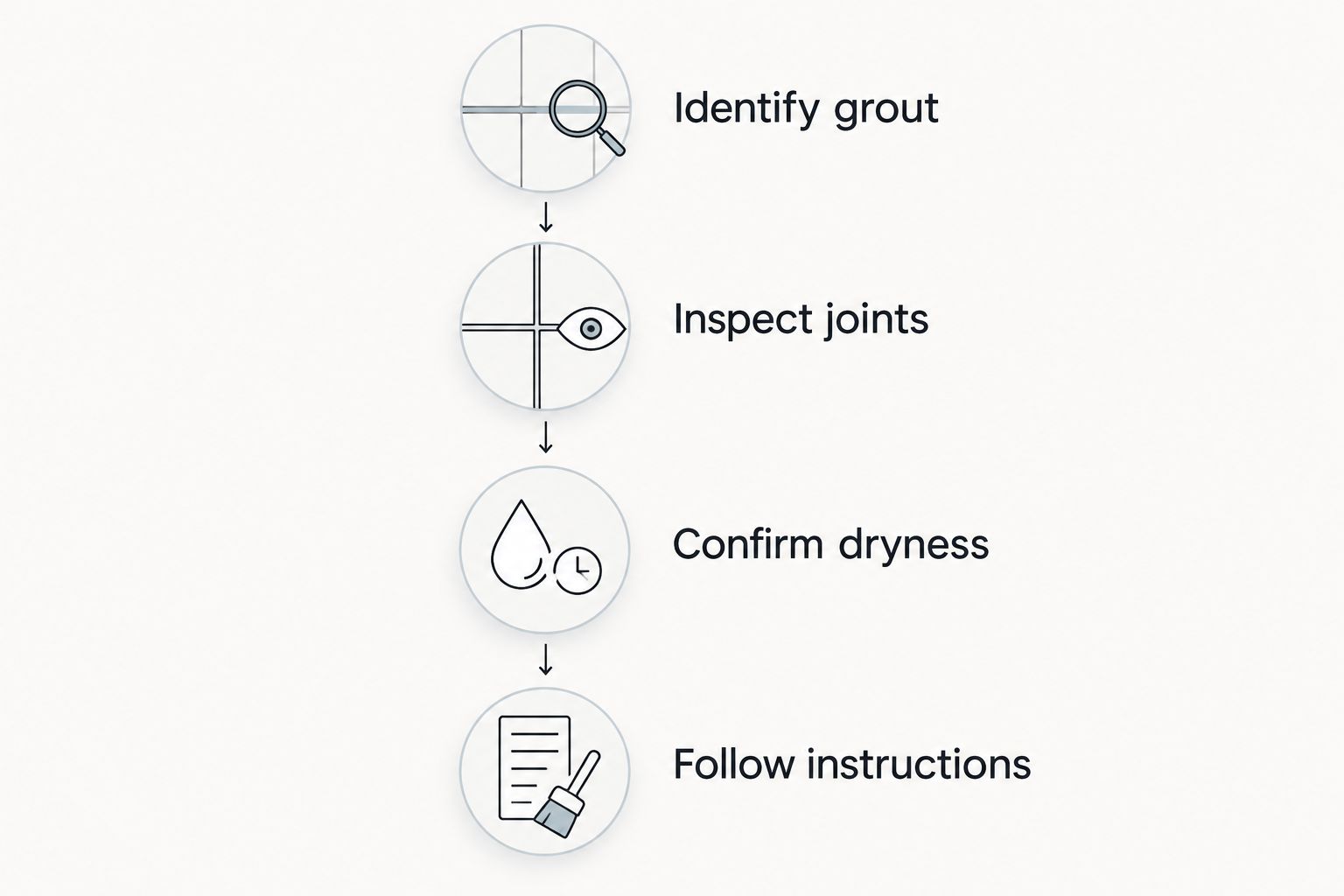
Use these 4 checks before application. They separate a sound sealing job from a rushed finishing step without imposing an unsupported drying deadline.
- Identify grout. Establish the grout type, surrounding material, and existing treatment as far as possible. Confirm that the proposed sealer is suitable for all surfaces it will contact.
- Inspect joints. Look for cracks, missing grout, loose material, remaining soil, and cleaning residue. Address those issues before covering the surface with another treatment.
- Confirm dryness. Follow the sealer's substrate-drying requirements. A surface that looks dry does not necessarily meet the product's application conditions.
- Follow instructions. Apply, remove excess, ventilate, and restrict use according to the specific product directions. Keep the care information for later maintenance.
Drying before application and curing after application are separate stages. Keep 2 separate instructions in your job notes: when the grout is ready for sealer, and when the treated surface is ready for its intended use. Do not substitute a carpet-drying estimate for either instruction.
For a 2026 appointment, ask for those instructions before scheduling other work in the room. That is especially useful when a kitchen, shared restroom, or business entrance cannot remain out of use without planning.
Does sealing restore grout to its original color?
A clear penetrating sealer is not a color-restoration treatment. Cleaning can remove discoloration caused by soil, but permanent staining, wear, and differences in the original installation can remain.
If color is the main concern, establish what cleaning can accomplish before discussing protection. The guide to whether grout cleaning restores its original color explains that separate question.
Do not approve clear sealing on the assumption that it will hide stains. Ask for a test area when appearance matters, and confirm whether the proposed product is clear, color-enhancing, or a separate color treatment. Those descriptions are not interchangeable.
Does grout sealer waterproof a shower?
Grout sealer does not waterproof a shower. A shower's water-management system depends on the installation beneath and around the tile, not a maintenance treatment applied to its grout lines.
Cracked joints, persistent dampness, loose tile, or signs of leakage require assessment. Adding sealer is not a repair for a failed waterproofing assembly, and a freshly cleaned surface does not establish that the underlying installation is sound.
Likewise, sealer does not solve the moisture conditions that support recurring mildew. Cleaning, ventilation, maintenance, and repair each address different parts of that problem.
Should you seal grout yourself or ask a professional?
DIY sealing is most appropriate when you can identify the material, confirm product compatibility, prepare it correctly, and follow every application instruction. Professional assessment is the better fit when the grout type is uncertain, natural stone borders the joints, or existing coatings complicate the job.
The trade-off is straightforward: doing the work yourself gives you control over the process, but also leaves you responsible for compatibility, residue removal, and protection during curing. Hiring help does not remove those requirements; it changes who performs and explains them.
Michaels Carpet Care's tile and grout cleaning serves North Texas homeowners and businesses seeking eco-friendly cleaning. The cleaning service is a fit for local surface care; grout sealing still needs its own material and condition assessment. Do not assume an additional treatment is included or appropriate without confirming the scope.
Before approving sealing, ask these 3 questions:
- What grout material is this, and why does it need sealing?
- Which sealer is compatible with the grout and surrounding surface?
- What preparation, drying, and aftercare instructions apply?
A useful recommendation answers all three without promising that grout will never stain again.
FAQ
Is grout sealing necessary after cleaning every time?
No. Grout sealing after cleaning depends on grout composition, absorption, existing protection, and manufacturer instructions—not simply whether cleaning occurred.
Can I seal grout immediately after professional cleaning?
Only when the grout meets the sealer manufacturer's preparation and drying requirements. Do not assume that a surface that looks dry is ready for application.
Does professional grout cleaning remove the old sealer?
Professional grout cleaning does not automatically remove every existing sealer. The result depends on the protective product, its condition, and the cleaning process.
Does epoxy grout need sealing after cleaning?
Epoxy grout generally does not need a penetrating grout sealer. Follow the grout manufacturer's instructions and continue routine cleaning to remove surface residue.
Will sealing stop grout from getting dirty again?
No. Sealing compatible grout reduces absorption, but surface dirt and spills still require cleaning. It does not make grout stain-proof or maintenance-free.
Can grout sealer fix cracks or stop shower leaks?
No. Grout sealer does not repair cracks, replace missing grout, or waterproof a shower installation. Those problems need assessment and appropriate repairs.
Can Michaels Carpet Care clean my tile before I decide about sealing?
Michaels Carpet Care provides tile and grout cleaning for homeowners and businesses in McKinney, Frisco, Plano, and Allen. Discuss grout identification, condition, and any proposed protective treatment when confirming the service scope.
One last thing
A lighter grout line is evidence of a cleaner surface, not proof that it needs sealer. Keep the decisions separate: judge cleaning by soil removal, repair by joint condition, and sealing by material compatibility and absorption.
When you save your 2026 service notes, include the grout identification and any treatment instructions. That record is more useful at the next appointment than a standing instruction to seal after every cleaning.