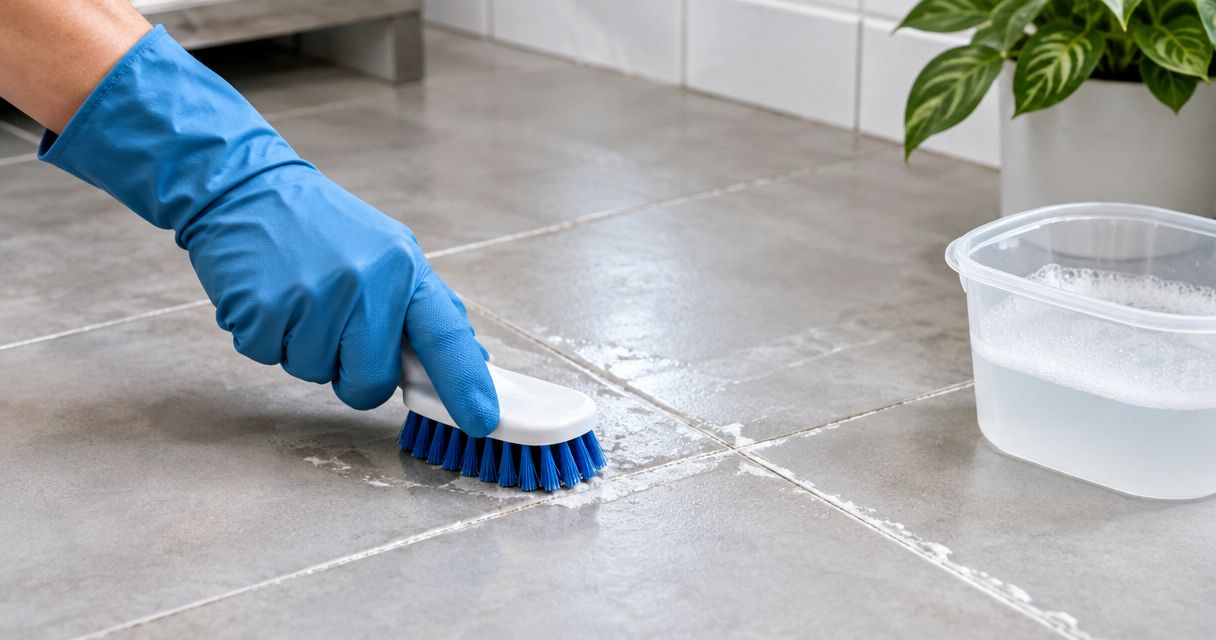
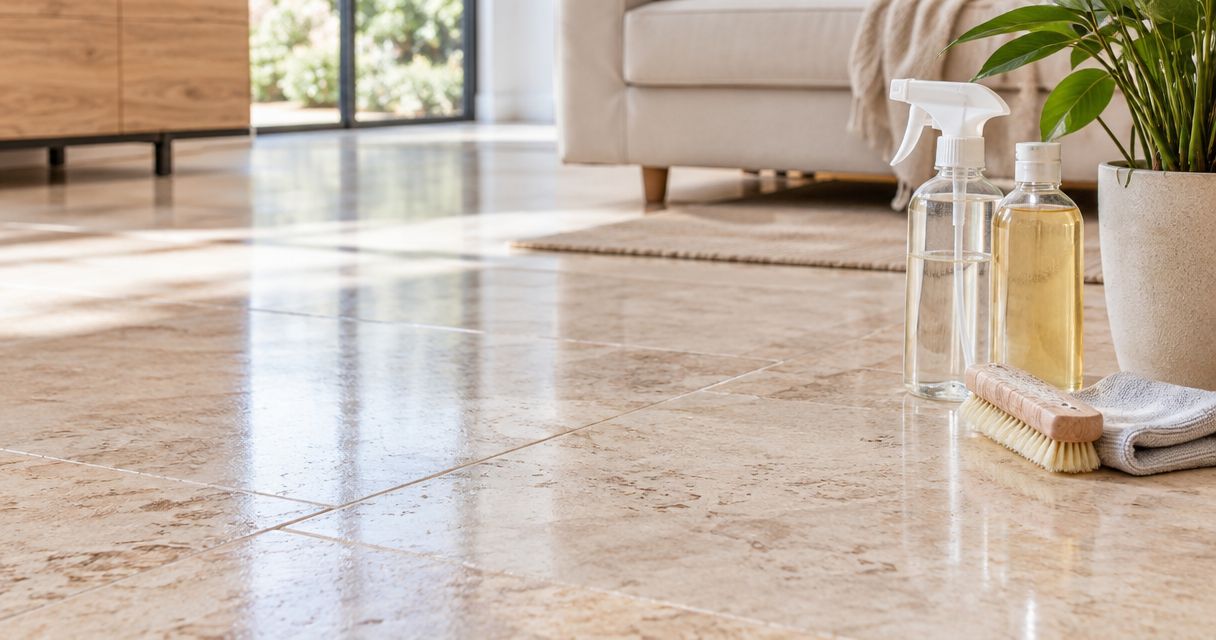
Best overall: a pH-neutral cleaner labeled for travertine. Best for convenient touch-ups: a ready-to-use stone cleaner. Best for light fresh spills: water and a clean microfiber cloth. This 2026 guide compares six cleaning options, including professional care from Michaels Carpet Care, and explains when each belongs on your floor.
- The best natural stone cleaners for travertine floors are stone-safe, pH-neutral products for routine cleaning.
- Choose ready-to-use stone cleaner for touch-ups and concentrate for whole-floor maintenance.
- Use alkaline stone cleaner for greasy residue only when its label explicitly permits travertine.
- Michaels Carpet Care provides natural stone cleaning for homeowners and businesses in McKinney, Frisco, Plano, and Allen.
- Cleaning removes soil; it does not repair acid etching or worn stone finishes.
Why this matters
Travertine is a calcium-carbonate stone. Acidic cleaners can dissolve its surface, leaving a dull mark called an etch rather than simply lifting dirt. Vinegar, acidic toilet cleaners, and products meant to remove mineral deposits are the wrong starting point.
Choose the cleaner for the stone, not just for the mess. A product that removes bathroom buildup from ceramic tile does not automatically belong on travertine. Sealing also does not make travertine acid-proof.
This 2026 ranking compares cleaner categories and cleaning approaches, not specific bottles. The distinctions matter: routine maintenance, oily residue, absorbed stains, and damaged finishes require different decisions. Professional cleaning is included as a service option, not presented as a household cleaning product.
What makes the best cleaner for travertine floors?
Use these criteria before choosing a product:
- Explicit stone compatibility: The label should permit travertine or the relevant calcium-based natural stone. A generic tile claim is not enough.
- Suitable chemistry: Choose pH-neutral products for routine cleaning. Neutral water has a pH of 7; a cleaner's suitability still depends on its complete formulation.
- Residue control: Follow dilution and rinsing directions. More concentrate does not mean a cleaner floor.
- Finish compatibility: Check whether the product suits polished, honed, filled, or textured stone.
- Problem match: Distinguish loose soil, grease, an absorbed stain, and surface damage before treating the floor.
- Clear instructions: Prefer labels that explain application, dilution, removal, and testing on an inconspicuous area.
Do not substitute a homemade mixture for the manufacturer's directions. Combining cleaners adds uncertainty without telling you whether the result is suitable for your stone.
Travertine cleaning options at a glance
The 2026 comparison below separates everyday maintenance from treatments that need more care. Each option has a different job; the order is not a claim that one method fixes every floor.
| Option | Best for | Standout feature | Key limitation |
|---|---|---|---|
| pH-neutral stone-cleaner concentrate | Whole-floor routine maintenance | Dilution matched to the label | Incorrect mixing can leave residue |
| Ready-to-use stone cleaner | Small-area touch-ups | No dilution step | Must still be labeled for travertine |
| Water and microfiber | Light fresh spills | Simple removal without added cleaner | Does not handle every oily or absorbed stain |
| Travertine-compatible alkaline cleaner | Greasy residue | Targeted cleaning beyond routine maintenance | Compatibility and rinsing require attention |
| Stone poultice treatment | Absorbed localized stains | Treatment directed at contamination within pores | Does not repair etching |
| Professional natural stone cleaning | Floors needing assessment | Service rather than another bottle | Cleaning is not the same as restoration |
1. pH-neutral stone-cleaner concentrate: best for routine maintenance
A pH-neutral stone-cleaner concentrate is the default choice for regular travertine floor cleaning. You mix it according to its label, apply it with appropriate equipment, and remove the dirty solution rather than allowing it to dry back onto the floor.
Start by removing loose grit. A wet mop dragged through abrasive debris does not replace that first step, and dirty cleaning water can spread soil between rooms.
pH-neutral concentrate pros:
- Suits a repeatable whole-floor maintenance routine when labeled for travertine.
- Provides a defined dilution rather than an improvised household mixture.
- Lets you prepare the amount of solution needed for the area.
pH-neutral concentrate cons:
- Requires accurate mixing and attention to rinse instructions.
- Does not correct etching, scratches, or worn polish.
Use a measuring container rather than pouring by eye. Keep the label with the bottle so another household member or cleaner can follow the same directions. If streaks remain, investigate residue and dirty tools before increasing the dose.
Best for: Homeowners maintaining an otherwise sound travertine floor.
Verdict: Buy a travertine-labeled pH-neutral concentrate for routine whole-floor cleaning.
2. Ready-to-use stone cleaner: best for convenient touch-ups
A ready-to-use stone cleaner removes the dilution step. Choose a formulation explicitly suitable for travertine, then follow its application and removal instructions for the area you are treating.
This category fits small messes and spot cleaning better than a complicated mixing routine. Ready-to-use describes preparation, however, not safety: a premixed cleaner can still contain chemistry that is wrong for calcium-based stone.
Ready-to-use stone cleaner pros:
- Eliminates measuring and mixing.
- Keeps small-area cleaning straightforward.
- Provides a consistent formulation when used as directed.
Ready-to-use stone cleaner cons:
- A generic tile spray is not automatically travertine-safe.
- Applying too much or leaving residue can create streaks.
Choose a cleaning product rather than assuming a cleaner-and-polish combination is necessary. Added shine is not the same as removed soil, and any product that leaves a coating deserves particular scrutiny on a walking surface.
Best for: Households wanting a simple product for localized touch-ups.
Verdict: Buy for convenience, but verify travertine compatibility before the first application.
3. Water and microfiber: best for light fresh spills
Water and a clean microfiber cloth are a sensible first response to a light fresh spill. Blot up the material, wipe gently, and dry the area instead of spreading the spill across neighboring tiles.
This approach is a cleaning method, not a bottled stone cleaner. It is useful precisely because you do not need to introduce additional chemistry for every small mess.
Water and microfiber pros:
- Removes light fresh soil without an added cleaning product.
- Makes immediate spill response simple.
- Allows you to dry the area as part of the same task.
Water and microfiber cons:
- Does not reliably remove greasy films or absorbed stains.
- A dirty cloth can redistribute soil rather than collect it.
For acidic spills, prompt removal matters even when the floor is sealed. Blot rather than rub, and do not attempt to neutralize the spill with another household chemical. If a dull patch remains after cleaning and drying, assess it as possible surface damage rather than continuing to scrub.
Best for: Light fresh spills before they become a larger cleaning problem.
Verdict: Hold off on stronger cleaners when water and a clean cloth remove the spill.
4. Travertine-compatible alkaline cleaner: best for greasy residue
An alkaline stone cleaner is a targeted option for oily or greasy soil that routine maintenance leaves behind. Use it only when the label explicitly permits your stone and finish, with dilution and rinsing handled as directed.
Do not treat alkaline chemistry as permission to use any heavy-duty degreaser. Stone compatibility, the surrounding materials, and the product's removal requirements still govern the choice.
Alkaline stone cleaner pros:
- Addresses greasy soil rather than treating every mark alike.
- Offers a distinct next step when routine cleaning is insufficient.
- Provides application instructions specific to the formulation.
Alkaline stone cleaner cons:
- Requires closer attention to dilution, rinsing, and adjacent surfaces.
- Cannot restore a finish damaged by acid or abrasion.
Test an inconspicuous area first and inspect it after drying. Protect nearby materials according to the label, and never mix the cleaner with another product. Stronger treatment should follow a clear diagnosis, not frustration with a stubborn mark.
Best for: Confirmed greasy residue on a floor compatible with the selected cleaner.
Verdict: Buy only for a defined grease problem, not as the everyday default.
5. Stone poultice treatment: best for absorbed localized stains
A stone poultice combines an absorbent material with a treatment selected for the stain. Its purpose is to address contamination within the stone's pores rather than simply wash the surface.
The treatment must match the stain and the stone. A dark mark from absorbed oil is a different problem from a pale, dull patch caused by acid exposure.
Stone poultice pros:
- Targets a localized absorbed stain.
- Addresses a problem that surface mopping does not solve.
- Keeps treatment focused on the affected area.
Stone poultice cons:
- Requires correct stain identification and suitable chemistry.
- Does not repair etching and does not guarantee complete stain removal.
Avoid homemade recipes chosen solely because an online photo resembles your floor. Follow the selected treatment's directions, including application and removal, or ask a stone-care professional to assess the mark. Repeatedly changing chemicals makes the treatment history harder to understand.
Best for: An identified stain that has penetrated below the surface.
Verdict: Wait until the stain is identified before choosing a poultice.
6. Professional natural stone cleaning: best for uncertain floor problems
Professional natural stone cleaning is the service option when the floor needs assessment rather than another product experiment. Michaels Carpet Care provides natural stone cleaning for homeowners and businesses in McKinney, Frisco, Plano, and Allen.
Michaels Carpet Care is a local natural stone cleaning option for homeowners and businesses across those four North Texas communities. Before arranging work, explain whether the concern is dirt, greasy residue, a localized stain, or a change in the stone's appearance.
Professional natural stone cleaning pros:
- Offers a service route for homeowners who do not want to select and apply treatments themselves.
- Provides an opportunity to discuss the floor's condition and cleaning history.
- Separates routine maintenance questions from problems needing further assessment.
Professional natural stone cleaning cons:
- Requires coordinating service rather than handling a quick touch-up yourself.
- Cleaning alone does not repair every etched, scratched, or worn surface.
Tell the provider which products have already been used. Ask what the proposed cleaning addresses and whether any remaining marks need a different service. Do not assume that polishing, honing, repairs, or sealing are included in a cleaning appointment.
Best for: North Texas homeowners and businesses seeking natural stone cleaning rather than more trial-and-error treatment.
Verdict: Buy the service when you need cleaning help; confirm the scope before booking.
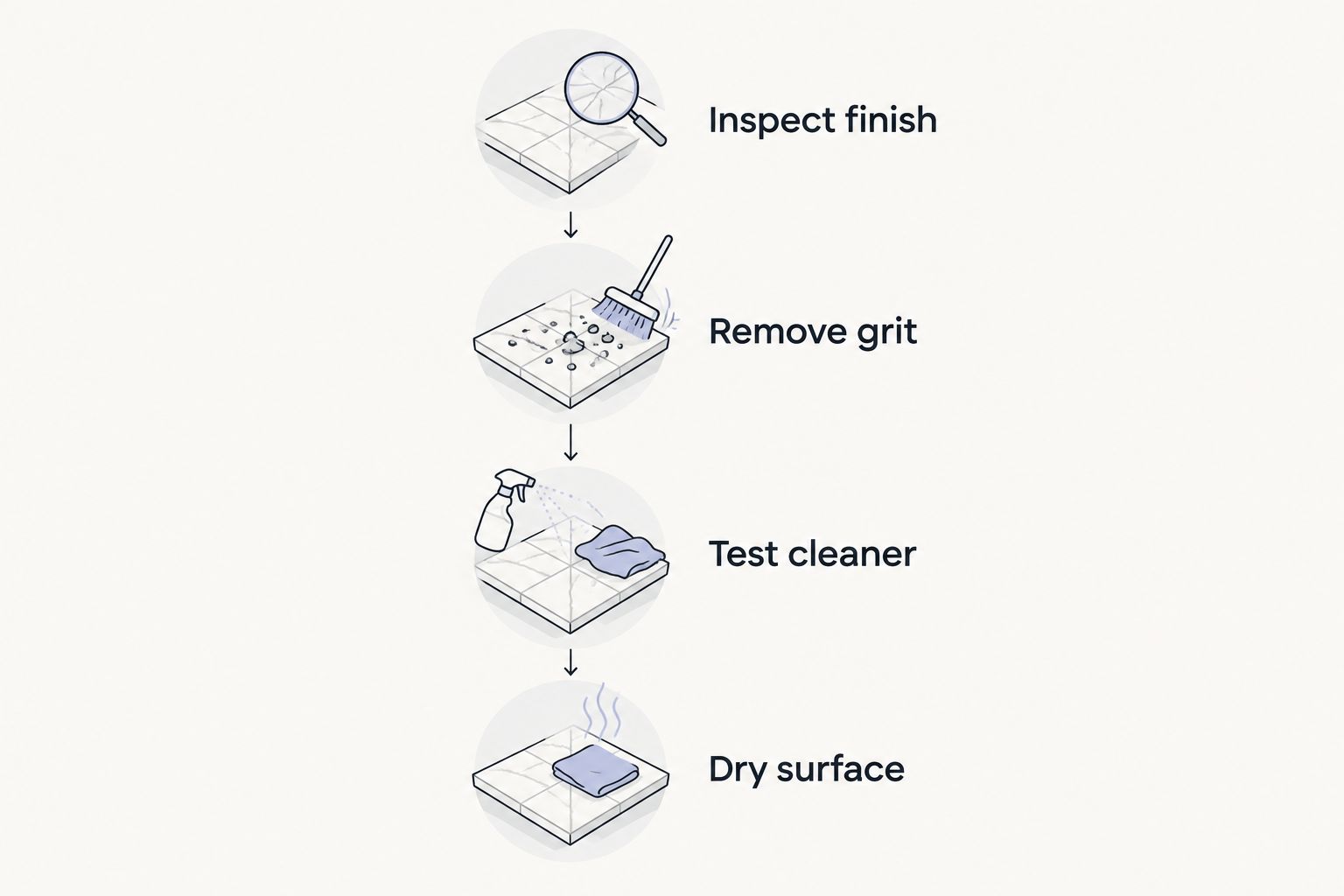
A safe cleaning sequence for 2026
Use this sequence before treating a travertine floor. It keeps the initial decision focused on the surface and the soil, not on the strongest bottle available.
- Inspect finish: Identify the visible problem and note whether the stone is polished, honed, filled, or textured.
- Remove grit: Collect loose debris before wet cleaning.
- Test cleaner: Follow label directions on an inconspicuous area and inspect the dry result.
- Dry surface: Remove dirty solution and dry as directed so you can judge the result clearly.
The sequence matters because a wet surface can disguise a dull patch. Evaluate the floor after drying before deciding that it needs another application.
For whole-floor cleaning, consider a 2-bucket setup: one bucket for prepared solution and another for rinsing the mop. Change dirty water rather than continuing to spread it. Follow the cleaner's instructions where they specify a different application method.
How the options were ranked
The ranking prioritizes explicit travertine compatibility, suitable chemistry, clear directions, and the problem each option addresses. Routine pH-neutral cleaning comes first because maintenance should not begin with a stain treatment or aggressive degreaser.
This 2026 guide does not rank bottles by fragrance, packaging, or promises of shine. Water, poultices, and professional cleaning appear because the correct response is not always another daily-use cleaner.
Which travertine cleaning option should you choose?
Choose a travertine-labeled pH-neutral cleaner when you need a default. Select concentrate for whole-floor maintenance or a ready-to-use formulation for touch-ups. Keep clean microfiber cloths available for immediate spill response.
Choose an alkaline stone cleaner only for compatible greasy-soil treatment, and reserve poultices for identified absorbed stains. For natural stone cleaning in the listed North Texas service areas, Michaels Carpet Care offers a local service option.
Your 2026 maintenance routine should stay simple: remove grit, clean with suitable chemistry, and investigate marks that cleaning does not change. Repeated scrubbing is not a diagnosis.
FAQ
What's the best natural stone cleaner for travertine floors?
A pH-neutral cleaner explicitly labeled for travertine is the best default for routine maintenance. Choose concentrate for whole-floor cleaning or a ready-to-use formulation for small touch-ups, and follow the label's application and removal directions.
Can I clean travertine floors with vinegar?
No, vinegar is acidic and can etch travertine. Use a cleaner labeled for calcium-based natural stone instead, and remove acidic spills promptly.
Is water enough to clean a travertine floor?
Water and a clean microfiber cloth are suitable for light fresh spills. Greasy residue and absorbed stains need a treatment matched to the problem rather than repeated wiping.
Is an alkaline cleaner better than a neutral cleaner for travertine?
An alkaline stone cleaner is a targeted option for greasy soil, not a better everyday default. Use it only when its label permits your travertine and finish, with dilution and rinsing handled as directed.
Will stone cleaner remove dull spots from travertine?
Stone cleaner does not repair dull spots caused by acid etching or worn finishes. Clean and dry the area first, then seek an assessment if the change remains.
Does sealed travertine still need a stone-safe cleaner?
Yes, sealed travertine still needs a stone-safe cleaner. Sealing does not make calcium-based stone resistant to acidic cleaning products.
Who provides natural stone cleaning around McKinney and Frisco?
Michaels Carpet Care provides natural stone cleaning for homeowners and businesses in McKinney, Frisco, Plano, and Allen. Describe the floor's condition and ask which concerns the proposed cleaning service addresses.
One last thing
A mark can be lighter than the surrounding stone because the surface has changed, not because dirt is sitting on top. If suitable cleaning leaves the same dull patch after drying, stop changing cleaners. Identify whether you are looking at a stain or damaged finish before the next treatment.