Best overall for quick reuse: dry compound cleaning. Best for routine commercial maintenance: encapsulation. Best for a restorative rinse: hot-water extraction. This 2026 guide to carpet cleaning methods ranked by drying time explains the trade-offs; Michaels Carpet Care is best for North Texas homeowners and businesses seeking fast-drying carpet cleaning.
- For carpet cleaning methods ranked by drying time, start with dry compound cleaning when quick reuse matters most.
- Michaels Carpet Care describes carpet drying in 1–2 hours with its low-moisture approach.
- Encapsulation suits routine commercial carpet maintenance; hot-water extraction suits work that needs rinsing.
- Choose carpet cleaning by fiber compatibility and soil removal, not drying time alone.
Why this matters
A carpet that looks clean but stays damp disrupts your day. You need to know when you can walk through the room, replace furniture, and resume normal use—not just when the technician finishes.
Drying time also answers a different question from cleaning effectiveness. A quick-drying surface treatment and a thorough extraction do different jobs. The best method removes the soil your carpet has without adding unnecessary moisture.
For your 2026 booking, separate three questions: which method suits the carpet, what it removes, and when the room returns to use. A fast answer to the last question does not settle the first two.
What makes the best fast-drying carpet cleaning method?
Use these criteria before choosing a method:
- Moisture input: Less liquid generally means less moisture to evaporate, but pretreatment also counts.
- Moisture recovery: Extraction equipment removes applied solution; drying depends partly on how much remains.
- Soil removal: Absorbing, vacuuming, surface transfer, and rinsing are different removal mechanisms.
- Carpet compatibility: Follow the carpet manufacturer's care instructions for fiber, backing, chemistry, and agitation.
- Room conditions: Air movement, indoor humidity, temperature, and carpet construction affect drying.
- Return-to-use requirements: Walking access, furniture replacement, and completion of post-cleaning vacuuming are separate milestones.
Ask for an estimate that covers your actual rooms. A method name alone cannot tell you how much pretreatment a heavily soiled area needs or whether a dense carpet will dry like a lighter one.
Carpet cleaning methods at a glance
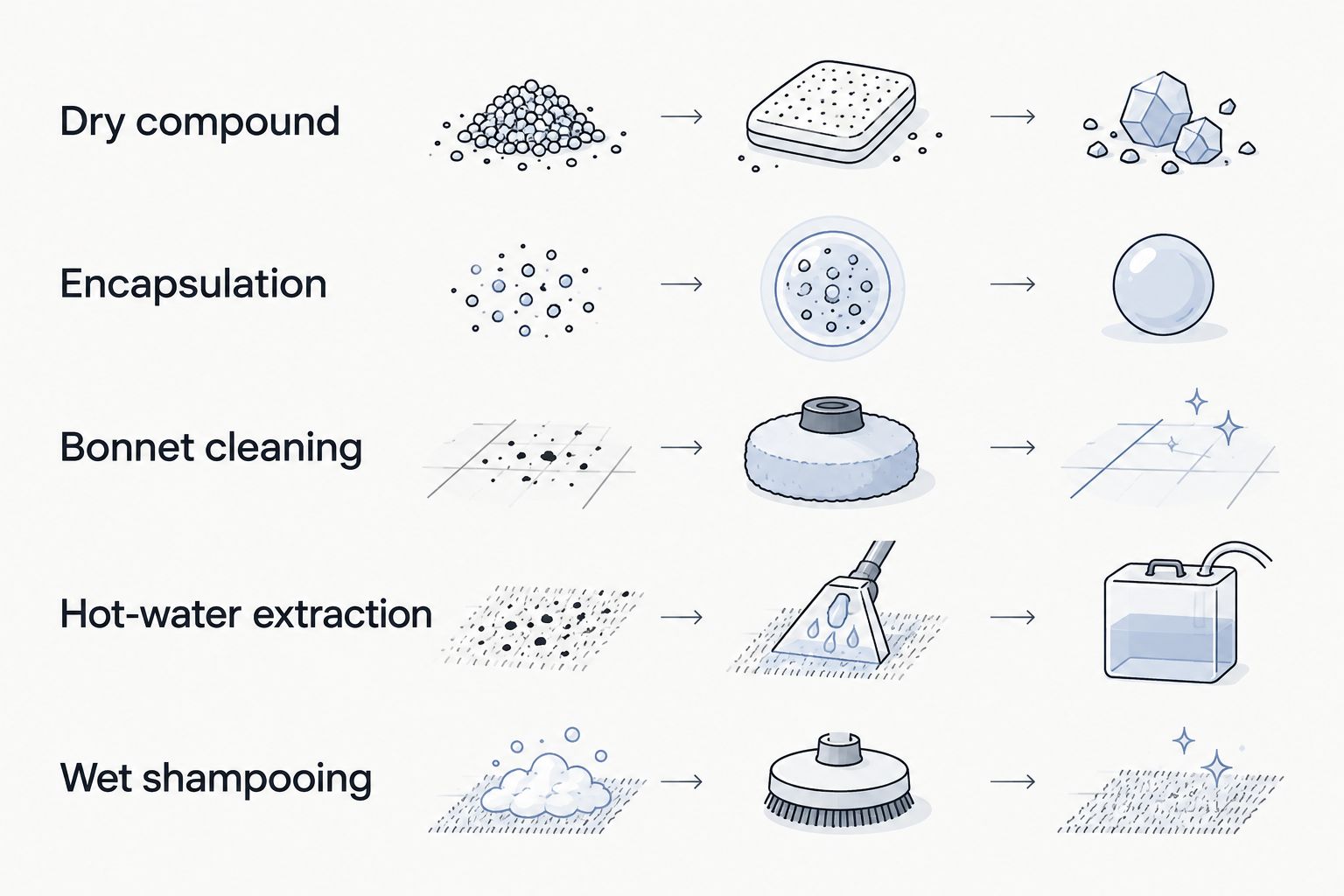
This is a practical drying-priority ranking for 2026, not a timed laboratory comparison. Dry compound cleaning leads because it avoids saturating the carpet. Encapsulation and bonnet cleaning occupy the low-moisture middle; their order can change with application and recovery. Wet shampooing sits last here when it leaves substantial moisture to dry.
| Rank and method | Best for | Standout feature | Drying-time position | Key limitation |
|---|---|---|---|---|
| 1. Dry compound | Quick room reuse | Absorbent compound is worked through the carpet and removed | First choice when minimizing wetting | Requires thorough compound removal |
| 2. Encapsulation | Routine commercial maintenance | Soil-containing residue is removed through vacuuming | Low-moisture option; application determines drying | Not a substitute for every restorative rinse |
| 3. Bonnet cleaning | Interim surface maintenance | A pad transfers soil from the carpet surface | Low-moisture option; overlaps with encapsulation | Limited cleaning below the surface |
| 4. Hot-water extraction | Restorative cleaning that needs rinsing | Applies solution and extracts water with suspended soil | Depends strongly on water recovery | More residual moisture can extend drying |
| 5. Wet shampooing | Compatible carpets needing foam agitation | Shampoo loosens soil through mechanical agitation | Less attractive when substantial moisture remains | Residue removal needs explicit planning |
Do not read the table as a promise that every encapsulation job dries before every extraction job. A lightly wetted, well-extracted carpet can behave differently from a heavily pretreated low-moisture job. Ask what happens on your carpet, not what happens in a generic demonstration.
1. Dry compound: best carpet cleaning for quick room reuse
Dry compound cleaning uses an absorbent cleaning material worked into the carpet, then removed according to the system's instructions. It cleans without the extensive wetting associated with wet cleaning methods. That makes it the first method to discuss when your main concern is getting the room back into use.
Michaels Carpet Care's brand information identifies Host Dry low-moisture technology and describes drying in 1–2 hours. It also describes water use as about 10% of what steam cleaning uses. Those are service-specific descriptions, not drying guarantees for every dry compound system.
Dry compound pros
- Limits the amount of liquid introduced into the carpet.
- Suits conversations about occupied rooms and quick reuse.
- Uses absorbent material rather than relying on a full wet rinse.
Dry compound cons
- Thorough removal of the cleaning compound is part of the job.
- It does not provide the same rinsing process as extraction.
- Localized stains still need assessment and compatible treatment.
Best for: Homeowners and businesses prioritizing a short interruption to normal room use.
Ask whether the estimate includes pretreatment, compound removal, and any additional work on spots. The stated 1-hour to 2-hour drying window should be discussed against your carpet and room conditions, rather than treated as a universal deadline.
Verdict: Buy dry compound cleaning when quick reuse is the priority and the method matches the carpet's care requirements.
2. Encapsulation: best carpet cleaning for commercial maintenance
Encapsulation applies a cleaning solution designed to leave a dry, soil-containing residue that subsequent vacuuming removes. It fits a maintenance program because cleaning and vacuuming work together. The job is not simply finished when the applied liquid stops feeling damp.
For an office or other regularly maintained carpeted space, ask who handles the follow-up vacuuming. You need a clear handoff between the cleaning provider and your routine cleaning staff.
Encapsulation pros
- Supports low-moisture maintenance of compatible carpet.
- Works with an ongoing vacuuming program.
- Offers an alternative to a full wet rinse for routine soil management.
Encapsulation cons
- Soil removal depends on effective subsequent vacuuming.
- Heavy soil or contamination can require a different treatment.
- Extra solution or spot treatment changes the drying expectation.
Best for: Commercial spaces with routine maintenance needs and dependable vacuuming.
For a 2026 maintenance plan, specify both the cleaning visit and the vacuuming responsibility. Otherwise, a fast-drying treatment can become an incomplete soil-removal process.
Verdict: Buy encapsulation for compatible commercial maintenance; skip it as an automatic replacement for restorative cleaning.
3. Bonnet cleaning: best carpet cleaning for interim surface care
Bonnet cleaning uses a rotating absorbent pad to transfer soil from the carpet surface. The pad needs changing or cleaning as it becomes soiled. This is surface-oriented maintenance, not the same process as flushing and recovering soil through extraction.
Its drying performance depends on how much solution the operator applies and how wet the pads become. The label alone does not establish a reliable advantage over encapsulation.
Bonnet cleaning pros
- Targets visible surface soil on compatible carpet.
- Provides an interim maintenance option between other cleaning work.
- Transfers soil to a pad that can be inspected and changed.
Bonnet cleaning cons
- Has limited reach below the carpet surface.
- Requires careful pad management to avoid redistributing soil.
- Must match the manufacturer's restrictions on rotary cleaning.
Best for: Interim surface maintenance where the carpet manufacturer permits the method.
Ask the provider how often pads are changed and what happens to soil beneath the surface. A cleaner appearance is useful, but it does not establish that deeper contamination has been removed.
Verdict: Hold until compatibility is confirmed; buy bonnet cleaning only for a clearly defined surface-maintenance job.
4. Hot-water extraction: best carpet cleaning for a restorative rinse
Hot-water extraction applies cleaning solution and recovers water along with suspended soil. People often call it steam cleaning, although the cleaning process centers on liquid application and extraction. Its defining advantage is rinsing and recovery, not minimum water use.
Drying depends on the liquid left behind. Equipment, technique, recovery passes, carpet construction, and room conditions all matter, so a blanket drying promise is less useful than an explanation of the actual process.
Hot-water extraction pros
- Provides a rinse-and-recovery step.
- Removes water and suspended soil through extraction.
- Addresses cleaning tasks where a surface-only approach is insufficient.
Hot-water extraction cons
- Residual moisture can delay normal room use.
- Excessive wetting or poor recovery creates an avoidable drying burden.
- Furniture placement and access need planning while carpet remains damp.
Best for: Compatible carpets needing restorative rinsing rather than surface maintenance alone.
If a previous extraction job stayed damp longer than expected, explain what happened before booking again. Ask how the provider controls moisture and confirms recovery; do not assume every extraction job will repeat the same result.
Verdict: Buy hot-water extraction when the cleaning task needs rinsing; skip choosing it solely for the shortest drying time.
5. Wet shampooing: best carpet cleaning for a defined foam process
Wet shampooing uses detergent foam and agitation to loosen soil. The important question is how that soil and the shampoo residue leave the carpet. Different systems handle recovery differently, so the word shampooing does not describe a complete cleaning plan.
This method ranks last for drying-priority selection when the process leaves substantial moisture behind. If extraction follows shampooing, judge the entire combined process rather than assigning a drying expectation to the foam stage alone.
Wet shampooing pros
- Uses agitation to loosen soil on compatible carpet.
- Offers a defined detergent-and-foam cleaning stage.
- Can form part of a process that includes effective recovery.
Wet shampooing cons
- Drying becomes a concern when moisture remains in the carpet.
- Residue and loosened soil need an explicit removal step.
- The method name does not establish the final result.
Best for: A professionally specified foam-cleaning process with confirmed compatibility and recovery.
Ask what remains after the carpet dries and how it is removed. If the answer covers only foam application, you do not yet have a complete description of the work.
Verdict: Skip wet shampooing for a drying-first booking unless the provider explains moisture recovery and residue removal.
How the methods are ranked
The 2026 ranking prioritizes limited wetting, then accounts for soil removal, carpet compatibility, and the steps needed to finish the job. It compares cleaning mechanisms, not measured results from identical rooms.
Dry compound is the default drying-first recommendation. Encapsulation and bonnet cleaning are maintenance choices with overlapping drying behavior. Hot-water extraction earns its place when rinsing matters more than minimizing moisture, while wet shampooing needs a clear recovery plan.
No method wins every cleaning task. Manufacturer instructions and the condition of the carpet take priority over its position in this list.
Which carpet cleaning method should you choose?
Choose by the job you need done:
- Quick room reuse: Discuss dry compound cleaning first.
- Routine commercial upkeep: Discuss encapsulation and the follow-up vacuuming schedule.
- Visible surface soil: Consider bonnet cleaning only after checking compatibility.
- Restorative rinsing: Discuss hot-water extraction and moisture recovery.
- Foam-based treatment: Require a complete explanation of soil and residue removal.
Michaels Carpet Care provides carpet cleaning for homeowners and businesses in McKinney, Frisco, Plano, and Allen. For your 2026 appointment, describe the carpet, the problem areas, and when you need the room usable. Ask whether the stated drying window applies to the full job, including spot treatment.
Discuss your carpet cleaning needs
Ask about low-moisture cleaning, problem spots, and drying expectations for your rooms.
FAQ
What's the fastest-drying carpet cleaning method?
Dry compound cleaning is the first method to consider when minimizing wetting is your priority. The actual return-to-use time depends on the cleaning system, spot treatments, carpet, and room conditions.
How long does Michaels Carpet Care say carpets take to dry?
Michaels Carpet Care describes carpet drying in 1–2 hours with its low-moisture approach. Confirm the expectation for your rooms and any additional stain treatment before the appointment.
Is encapsulation faster to dry than bonnet cleaning?
Neither method has a guaranteed drying advantage over the other. Both can use limited moisture, and application amount, carpet construction, and room conditions determine the result.
Is steam cleaning the same as hot-water extraction?
Steam cleaning commonly refers to hot-water extraction in carpet-cleaning discussions. Hot-water extraction applies cleaning solution and recovers water and suspended soil; ask for the actual method rather than relying on the label.
Does faster drying mean the carpet is cleaner?
No, drying speed does not measure soil removal. Choose a process that addresses the soil and follows the carpet manufacturer's care instructions, then consider drying time.
Can I put furniture back as soon as the carpet feels dry?
Follow the cleaning provider's furniture-replacement instructions rather than judging only by surface feel. Ask whether furniture needs protective tabs or blocks and when they can be removed.
What's the best method for pet stains and odors?
Choose pet-stain treatment by where the contamination is, not by drying speed alone. Tell the provider about repeat accidents and persistent odors so the assessment includes more than the visible spot.
One last thing
A dry surface is not a complete cleaning result. Encapsulation still depends on vacuuming, dry compound still needs removal, and a surface treatment does not establish that deeper soil is gone.
Before the technician leaves, ask one question: What still needs to happen before this carpet is ready for normal use? That answer is more useful than a drying estimate by itself.