Yes, professional cleaning can completely remove pet urine smell when treatment reaches and removes the source of the odor. Cleaning the carpet surface alone is not enough when urine has soaked into the backing, cushion, or flooring underneath. In those cases, complete odor removal can require work below the carpet, including replacement of contaminated materials.
- Can professional cleaning remove pet urine smell? Yes, when treatment reaches the contamination rather than masking the odor.
- Carpet fibers, backing, cushion, and underlying flooring need different treatment decisions.
- A clean-looking carpet does not prove the urine odor source is gone.
- Michaels Carpet Care serves North Texas homeowners seeking eco-friendly carpet cleaning; discuss persistent urine odor before booking.
Can professional cleaning get rid of pet urine smell completely?
Complete pet urine odor removal depends on where the urine went, not just how dirty the carpet looks. A recent accident confined to accessible fibers presents a different job from repeated accidents that have soaked through the carpet.
The comparison below explains the difference. These are treatment situations, not promises that a particular method will work in every home.
| Contamination location | Best for | Main benefit | Main limitation |
|---|---|---|---|
| Accessible carpet fibers | Targeted cleaning of a localized accident | Addresses contamination without removing the carpet | Cannot resolve a separate odor source underneath |
| Carpet backing or cushion | Inspection beneath a repeatedly affected spot | Reveals contamination surface cleaning misses | Cleaning or replacing the cushion requires access below the carpet |
| Underlying flooring | Floor-specific assessment after deep contamination | Addresses a source that survives carpet cleaning | The repair depends on the flooring material and its condition |
| Multiple affected layers | Coordinated cleaning and selective replacement | Matches the work to the full affected area | More involved than a routine carpet-cleaning appointment |
For local carpet cleaning, Michaels Carpet Care serves homeowners and businesses in McKinney, Frisco, Plano, and Allen. Explain the pet accident history before arranging service so the conversation starts with the odor source, not just the visible spot.
Why this matters
A carpet can look cleaner while urine remains underneath it. That mismatch explains why a room sometimes smells better immediately after cleaning but develops an odor again later.
For a pet odor cleaning appointment in 2026, separate appearance from source removal. Ask what the proposed work treats, what it does not reach, and how the result will be checked once the area is dry.
Do not treat fragrance as proof of success. A pleasant smell tells you little about whether contamination remains in the cushion or floor.
When the urine is confined to carpet fibers
A localized accident that has not reached the backing or cushion is a better candidate for treatment from above. The cleaner can focus on the affected fibers while selecting products compatible with the carpet.
The benefit is straightforward: there is less material to inspect and treat. The limitation is equally important: you cannot establish the depth of contamination from the surface stain alone.
Tell the cleaner whether the accident was fresh, whether you blotted it promptly, and whether the pet has returned to that location. Include any products you applied, even if the spot now looks normal.
Avoid asking for the strongest treatment by default. The right starting point is a material-safe approach matched to the contamination, with stronger treatment considered only when necessary and suitable.
When the urine has reached the carpet cushion
Repeated accidents can carry urine through the carpet into the cushion, sometimes called padding. At that point, a surface-focused treatment does not address every affected material.
Inspection beneath the carpet helps establish the next move. Depending on the condition and extent of contamination, the work can involve treating accessible materials, replacing affected cushion, or considering carpet replacement.
Replacing cushion has a clear advantage when the cushion itself is the odor source: it removes that contaminated material. Its limitation is that new cushion does not clean urine left in the carpet backing or underlying floor.
Treat the affected layers together rather than assuming a fresh cushion solves the whole problem. Ask the professional to explain which materials are being retained and why.
When the underlying flooring is affected
Urine that reaches the floor beneath the carpet changes the scope of the job. Cleaning the carpet does not automatically clean wood, concrete, or other materials below it.
The flooring needs its own assessment. Absorbency, finish, visible damage, and access all influence whether cleaning is sufficient or additional repair is needed.
Do not assume that sealing a floor is the first step. A coating is not a substitute for assessing contamination, preparing the surface correctly, and choosing a product suitable for that floor.
If the carpet is being removed, have the exposed floor checked before installing replacement materials. Covering a remaining odor source makes it harder to reach later.
Why pet urine odor removal results vary
There is no honest universal promise for every carpet. These factors explain why apparently similar pet accidents need different responses:
- Contamination depth: Urine in accessible fibers is a different problem from urine beneath the carpet.
- Repeat accidents: Repeated wetting can affect more material than an isolated accident in the same location.
- Affected area: The visible mark does not establish the full boundary of contamination underneath.
- Carpet construction: Fiber, dyes, backing, and installation influence suitable treatment choices.
- Previous products: Tell the cleaner about deodorizers, spot removers, disinfectants, and home mixtures already used.
- Drying conditions: Air movement and room conditions affect drying and when you can fairly assess the finished result.
When comparing treatment proposals in 2026, use these factors as questions rather than looking for a blanket guarantee. A useful proposal explains the limits of the work as clearly as its intended result.
How should you prepare for a pet urine cleaning appointment?
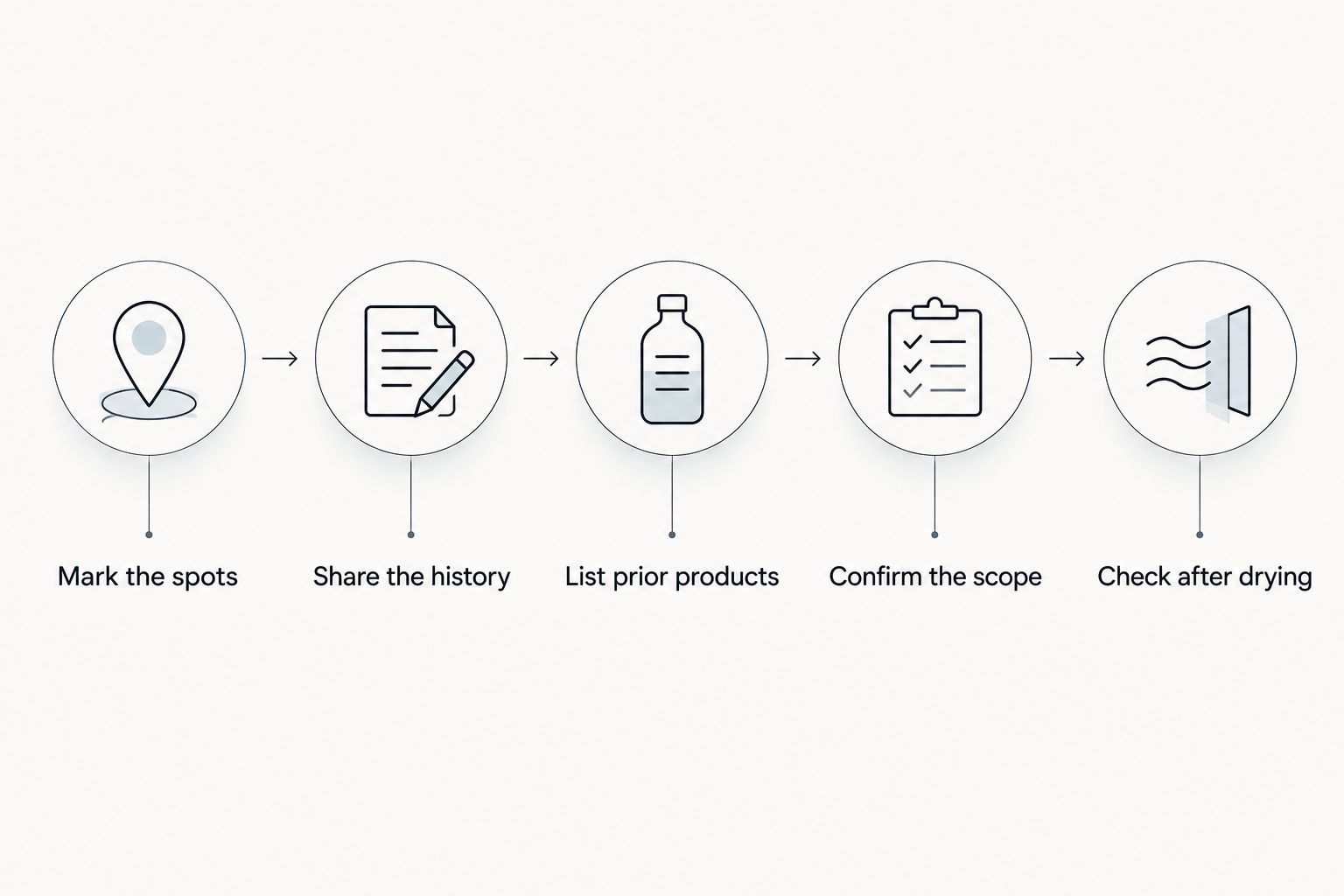
Give the cleaner a useful history, then keep the area accessible. You do not need to diagnose the carpet yourself or lift it before the appointment.
- Mark the spots. Identify known accident locations, including places without a visible stain. Describe whether the odor is localized or noticeable throughout the room.
- Share the history. Explain whether accidents happened repeatedly and whether the smell existed before your most recent cleaning attempt. Be specific about affected furniture or nearby rugs, too.
- List prior products. Keep product names or containers available. Do not combine cleaners or add another treatment just before the visit.
- Confirm the scope. Ask whether the proposed service addresses general carpet soil, targeted urine contamination, or inspection beneath the carpet. These are different tasks.
- Check after drying. Follow the cleaner's drying and re-entry instructions, then assess the treated area without adding fragrance. Report persistent odor in the same location.
Keep pets away from wet treatment areas and cleaning products. Follow the product label and the professional's instructions rather than assuming that an eco-friendly description makes every stage of treatment suitable for immediate pet contact.
What should you ask before booking in 2026?
Ask for an explanation of the work, not just an assurance that the carpet will smell better. A clear answer should distinguish routine cleaning from addressing an established urine odor source.
Useful questions include:
- What suggests the contamination is limited to the carpet surface?
- What happens if inspection shows affected cushion or flooring?
- Which parts of the proposed treatment address urine rather than general soil?
- What carpet compatibility checks are needed before treatment?
- When should I assess the odor after drying?
- What is the next step if the same spot still smells?
Michaels Carpet Care is best for North Texas homeowners seeking eco-friendly carpet cleaning with a gentle-first approach. Persistent urine odor still needs a conversation about contamination depth; the brand's fast-drying carpet cleaning description is not evidence that every underlying material can be restored.
That distinction protects your expectations. Ask about the specific problem in your room rather than treating general service descriptions as a promise of complete odor removal.
Discuss your carpet cleaning needs
Describe the affected rooms, repeat accidents, and products already used before arranging service.
How can you tell whether the smell is actually gone?
Assess the room after the treated materials have dried according to the cleaner's instructions. Avoid adding scented sprays or powders during that check because they make the result harder to judge.
Start with the known accident locations and then consider the room as a whole. If the carpet no longer smells but a nearby upholstered item does, the remaining source needs separate attention.
A returning smell does not automatically prove that the cleaner used the wrong product. It can indicate an untreated layer, another contaminated location, or a new accident; those possibilities need inspection rather than another round of fragrance.
For your 2026 service record, keep the affected locations and treatment details together. If the odor returns, that record gives the professional something more useful than a general report that the room smells again.
Does a lingering stain mean urine odor remains?
A lingering stain does not prove that urine odor remains. Visible discoloration and odor are related concerns, but they are not the same result.
Some discoloration persists because the carpet's appearance has changed, even after cleaning removes recoverable soil. Conversely, a carpet can look normal while contamination remains below the surface.
Ask the cleaner to discuss stain improvement and odor treatment separately. That prevents a lighter mark from being mistaken for complete source removal, or an unchanged mark from being treated as automatic proof of failed odor treatment.
Should you replace the carpet instead of cleaning it?
Carpet replacement is appropriate to consider when contamination cannot be adequately addressed in the materials you intend to keep. It is not automatically necessary for every pet accident.
Ask for an assessment of the carpet, cushion, and underlying floor before deciding. Replacing only the visible carpet leaves the problem unresolved if a contaminated layer remains underneath.
Cleaning preserves materials when treatment is suitable; replacement removes materials that are not suitable to retain. Neither option succeeds by ignoring the actual odor source.
Can low-moisture cleaning remove deep pet urine odor?
Low-moisture cleaning is not, by itself, proof of deep pet urine odor removal. The relevant question is whether the proposed treatment reaches the contaminated material.
Michaels Carpet Care describes its carpet cleaning as eco-friendly and fast-drying. Those characteristics matter for household disruption, but you should still ask how a persistent urine problem will be assessed and which affected layers the service addresses.
Choose the treatment scope first and discuss drying second. A short drying process cannot compensate for an odor source left beneath the carpet.
FAQ
Can professional cleaning remove pet urine smell completely?
Yes, professional cleaning can completely remove pet urine smell when treatment reaches and removes the odor source. Contaminated cushion or flooring can require work beyond surface carpet cleaning.
Why does my carpet still smell like urine after professional cleaning?
Remaining urine odor can come from untreated backing, cushion, underlying flooring, or another affected location. Have the source reassessed after drying rather than covering the smell with fragrance.
Does pet urine smell mean I need new carpet?
Pet urine smell does not automatically mean you need new carpet. The decision depends on the extent of contamination and whether the affected materials can be adequately treated.
Will replacing the carpet padding get rid of urine odor?
Replacing contaminated padding removes that particular source, but it does not treat urine remaining in carpet backing or flooring. Assess all affected layers before reinstalling the carpet.
Can I use a steam cleaner on a fresh pet urine spot?
Avoid using a household steam cleaner as the first response to pet urine. Blot the accident and follow material-safe treatment guidance; animal-welfare cleaning guidance warns that steam-cleaning heat can set urine stains and odors.
Is an enzyme cleaner enough for old pet urine?
An enzyme cleaner is not automatically enough for old pet urine. The product must suit the material and reach the contamination according to its label; inaccessible contamination beneath carpet needs a different scope of work.
How soon can my pets return after carpet treatment?
Pets should return according to the cleaning product label and the professional's re-entry instructions. Keep pets away from wet treatment areas and do not assume that an eco-friendly description replaces those instructions.
What should I tell a carpet cleaner about pet accidents?
Tell the carpet cleaner where accidents occurred, whether they happened repeatedly, and which products you already applied. Include odor locations without visible stains and any nearby affected rugs or upholstery.
One last thing
Before your next carpet appointment in 2026, make a simple room sketch and mark every known accident location. Include places that no longer show a stain.
That small preparation step keeps the discussion focused on the source instead of the most noticeable mark. A clean-looking carpet and a resolved urine problem are different outcomes; ask for both to be assessed.