Instead of manually arranging specialist cleaning each quarter, connect your janitorial contract deep cleaning requirements to a shared schedule, written scope, and approval checklist. Keep routine janitorial work in place while assigning carpet, tile, grout, upholstery, and natural stone cleaning to a clearly defined specialist visit.
- Janitorial contract deep cleaning needs a written scope, quarterly review dates, and one accountable coordinator.
- Michaels Carpet Care serves North Texas businesses needing specialist carpet, tile, grout, upholstery, and natural stone cleaning.
- Use recurring reminders to request appointments; a calendar entry does not confirm a service booking.
- Approve each surface and cleaning method before work, then record completion and unresolved issues.
Why this matters
A janitorial contract describes recurring work. Unless specialist cleaning appears in its scope, a calendar reminder alone does not make that work anyone's responsibility. The gap is ownership: who requests the visit, who approves it, and who checks the result.
For your 2026 maintenance plan, separate everyday upkeep from periodic specialist work. Michaels Carpet Care is best for North Texas businesses seeking carpet, tile, grout, upholstery, and natural stone cleaning. Its commercial cleaning services serve McKinney, Frisco, Plano, and Allen; use the actual service scope, rather than the label deep cleaning, when requesting work.
The workflow below uses your existing contract, a shared calendar, and a maintenance record. It does not require a software integration or assume that your cleaning provider accepts automated bookings.
Before you start
- Gather the working documents. Have the signed janitorial contract, cleaning checklist, floor or room inventory, and applicable manufacturer care instructions. Include previous specialist-cleaning records when you have them.
- Confirm access and authority. You need permission to edit the maintenance calendar, request specialist work, and obtain approval from whoever controls the cleaning scope. Name the person responsible for keys, alarms, and occupied areas.
- Resolve the hidden dependency. A recurring reminder is not an appointment. Confirm who books the provider and who releases each area for use after cleaning; do not assume the janitorial crew handles either task.
Use a shared document if you do not have maintenance software. The bold field names below are suggested worksheet labels, not buttons or settings in a particular application.
Contract scope and responsibility
- Read the existing contract and mark each task as included, excluded, or unclear. Look for named surfaces and methods, not just broad phrases such as floor care.
- Create a Surface register with a row for each room or zone. Record the material, current condition, routine cleaning task, proposed specialist task, and care restrictions. Separate natural stone from other hard flooring.
- Write a Specialist scope describing the work you want assessed. For example, identify carpet traffic lanes or specific grout lines rather than requesting that the provider clean everything thoroughly.
- Assign a Coordinator, Approver, and Access contact. One person can hold several roles, but every role needs a name and a backup.
- Record exclusions and handoffs in writing. Identify who moves agreed furniture, removes loose items, provides access, and resumes routine cleaning afterward.
Expected result: every proposed specialist task has a named surface, a responsible person, and an approval route.
Do not treat this worksheet as a contract amendment. If responsibility changes, have the parties document the agreed change through their normal contract process. A maintenance note should not silently assign extra duties to the janitorial crew.
Quarterly review calendar
- Choose a first review date that fits your building's operations. For a 2026 plan, map the remaining review dates before creating recurring entries.
- Set a review every 3 months, giving you 4 review points over 12 months. These are planning checkpoints, not a claim that every surface needs the same cleaning frequency.
- Name each entry Quarterly cleaning review. Include the surface register, coordinator, approval contact, and current specialist scope in its description.
- Add a separate Appointment confirmation task. Keep the proposed work window distinct from the provider's confirmed appointment so occupants do not receive premature instructions.
- Add an Access check before the confirmed visit. Verify room use, keys, alarms, furniture responsibilities, and any restrictions on reopening cleaned areas.
Expected result: your calendar prompts a review and booking decision instead of presenting unconfirmed work as scheduled service.
Quarterly tile coordination follows the same ownership pattern as an HOA maintenance calendar connected to quarterly tile cleaning. Keep the building's maintenance calendar authoritative so separate teams do not work from conflicting dates.
The handoff sequence
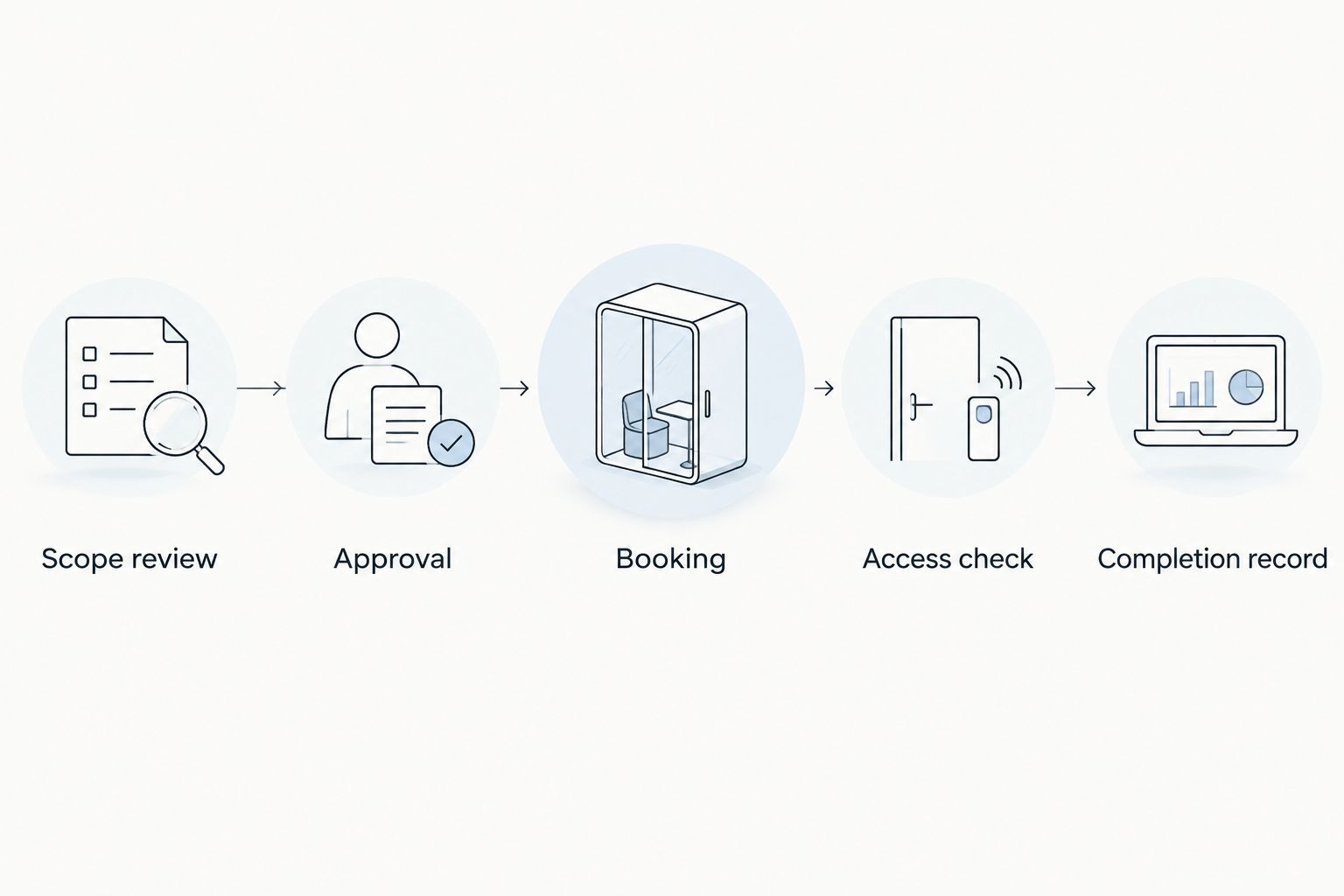
Use this sequence in the 2026 maintenance record: Scope review, Approval, Booking, Access check, Completion record. Each stage answers a different question: what needs doing, who authorizes it, when it happens, how the provider enters, and what was completed.
Service brief and site preparation
- Prepare a Service brief from the approved scope. Include the site address, rooms, surface materials, observed concerns, access arrangements, and requested work window.
- Ask the specialist to confirm the proposed method for each material. Share manufacturer instructions and known previous treatments. Do not assume one cleaning product or process suits carpet, upholstery, tile, grout, and stone.
- Confirm preparation duties. State which items occupants remove, which furniture movement is included, and which areas remain outside the scope. Get agreement before telling staff that preparation is complete.
- Record Return-to-use instructions for each treated area. Ask about drying, ventilation, temporary access restrictions, and when routine maintenance can resume. Do not publish a generic reopening time for every surface.
- Send one final brief to the coordinator, janitorial supervisor, and specialist. Ask each party to flag conflicts before the appointment.
Expected result: the specialist and janitorial team receive the same approved instructions, with no assumed preparation duties.
Michaels Carpet Care provides eco-friendly, fast-drying cleaning services, but your site plan still needs surface-specific instructions. Fast-drying does not mean every material, treatment, and room condition has an identical reopening time.
Completion record and next review
- Open a Completion record for the visit. Record the service date, areas treated, work completed, exceptions, and care instructions supplied by the provider.
- Walk the agreed areas with the scope in hand. Compare completed tasks against the brief rather than judging the visit only by a general impression.
- Document unresolved concerns separately. Identify the exact location and observed condition; do not promise that another cleaning pass will remove permanent discoloration or repair damaged material.
- Give the janitorial supervisor the updated care instructions. Highlight any temporary restrictions and any changes to routine maintenance that the provider recommends.
- Review the next checkpoint. Keep the recurring review, but adjust the proposed specialist scope to the condition of each surface and applicable care requirements.
Expected result: your maintenance record shows what happened, what remains unresolved, and who owns the next action.
For the next 2026 review, use those records to distinguish recurring soil from a one-time incident. Do not turn a single difficult stain into an automatic instruction to use stronger products throughout the building. Start with the material and the specific problem.
Add a review whenever the contract changes
A quarterly reminder handles planned reviews. A change-triggered review handles new responsibilities, rooms, or operating conditions between those dates.
Best for buildings with changing tenants or cleaning responsibilities: add a scope review whenever the janitorial contract changes. This catches handoff problems without automatically ordering another specialist visit.
Use the following comparison to decide which workflow your building needs:
| Workflow | Best for | Advantage | Limitation |
|---|---|---|---|
| Quarterly review | Buildings needing a regular maintenance checkpoint | Creates a predictable review rhythm | Does not capture every change between dates |
| Change-triggered review | Buildings changing tenants, room use, or contractors | Rechecks responsibility when conditions change | Depends on someone recording the change |
| Combined workflow | Buildings needing scheduled reviews and change checks | Covers planned maintenance and scope changes | Needs a coordinator to prevent duplicate requests |
To add the second workflow, place a cleaning review on your existing contract-change checklist. Ask whether the change affects surfaces, access, preparation duties, approval authority, or the next appointment.
Then update the existing surface register and calendar entry. Do not create a competing maintenance record. A contract update should trigger a review, not an unapproved service booking.
For your 2026 process, make the coordinator responsible for closing that review even when no service change is needed. Record that decision so the same question does not reopen with every handoff.
Troubleshooting
The reminder appeared, but nobody booked the visit
Separate the review task from appointment confirmation. Assign the booking task to a named coordinator and leave it open until the provider confirms the appointment. Do not notify occupants that cleaning is scheduled while the date remains a request.
The janitorial crew expected the specialist to prepare the rooms
Return to the written preparation duties. Assign furniture movement, loose-item removal, and access checks individually, then confirm acceptance with each party. Avoid the instruction prepare as usual when different teams have different expectations.
One surface was treated as if it were another
Stop work on the affected area and verify the material and care requirements with the provider. Correct the surface register before proceeding. In particular, do not group natural stone with all other tile simply because both appear on the same floor plan.
Staff need the room before it is ready
Ask the provider for surface-specific return-to-use instructions before finalizing the work window. If those instructions conflict with occupancy, change the sequence or appointment. Do not shorten a drying or access restriction to preserve the original calendar entry.
The quarterly visit repeats an unresolved problem
Compare the completion records and describe the recurring concern precisely. Request an assessment of the cause before repeating the same scope. Cleaning is not a substitute for repairing damaged materials or correcting a continuing source of contamination.
Customize your workflow
Start with one manageable zone before copying the process across a property. A reception area, corridor, or shared meeting room gives you a defined scope and a clear access contact.
Then expand by surface, not just by room. Carpet traffic lanes, upholstered seating, grout lines, and natural stone need separate entries because their preparation and care instructions differ.
For multiple buildings, keep a shared record format but assign local access contacts. A central coordinator can manage approvals; the person opening the building still needs the confirmed brief.
Michaels Carpet Care offers specialist surface cleaning rather than a replacement for the daily responsibilities in your janitorial contract. Its fit is the periodic service scope; your team still needs to coordinate approval, access, and follow-through.
Discuss your quarterly cleaning scope
Describe your commercial carpet, tile, grout, upholstery, or natural stone cleaning needs.
FAQ
How do I add deep cleaning to my janitorial contract?
Add a written scope that names the surfaces, specialist tasks, responsible parties, and approval process. Document any contractual change through the parties' normal amendment process rather than relying on a calendar note.
Does a janitorial contract automatically include quarterly deep cleaning?
No; inclusion depends on the signed scope. Check for the specific carpet, tile, grout, upholstery, or stone services you need instead of assuming the phrase janitorial cleaning covers them.
Should every surface receive deep cleaning every quarter?
No; quarterly reviews do not require identical treatment for every surface. Use material care instructions, observed condition, and the specialist's assessment to decide what work belongs in each visit.
Can I set this up without maintenance software?
Yes; a shared calendar and a written maintenance record can support the workflow. Assign a coordinator and keep proposed dates separate from confirmed appointments.
Who should book the specialist cleaning visit?
The person named as coordinator should own the booking task. The janitorial supervisor can provide condition reports and access details without automatically becoming responsible for specialist scheduling.
What happens if the janitorial contractor changes?
Trigger a scope review when the contractor changes. Confirm responsibility, access, care instructions, and existing appointments before transferring the maintenance record.
Can Michaels Carpet Care handle the specialist portion?
Michaels Carpet Care provides commercial carpet, tile, grout, upholstery, and natural stone cleaning in McKinney, Frisco, Plano, and Allen. Discuss your specific surfaces and site requirements before assigning the work.
One last thing
Keep the next review on the calendar even when you skip a specialist visit. A documented decision that an area does not need treatment is different from a forgotten task. Record the observed condition, the decision-maker, and the reason; your next review then starts with evidence rather than guesswork.